



How Different Types of Magnesium Support Memory, Focus and Cognitive Function – Which Magnesium Is Best for Brain Health? Evidence-Based Comparison of Magnesium L-Threonate, Bis-Glycinate and More
Executive Summary
Magnesium is involved in over 300 hundreds of biochemical reactions throughout the body, but its role in the brain is especially important. It helps nerve cells communicate, supports energy production, regulates neurotransmitters and contributes to learning and memory. Yet not all magnesium supplements are the same.
Some forms are better absorbed, while others may have unique effects on the brain. Among the available options, Magnesium L-Threonate has attracted significant scientific interest because it appears to increase magnesium levels within the brain more effectively than conventional magnesium salts. However, it is not necessarily the best choice for everyone.
This evidence-based guide explains how magnesium supports brain function and compares the most common magnesium supplements based on the latest scientific research.
Key Points – Why Magnesium is critical for Human Health
-
Magnesium plays a critical role in memory, learning, attention and healthy brain ageing
-
Different magnesium supplements are absorbed differently by the body
-
Magnesium L-Threonate has the strongest research specifically targeting brain magnesium levels
-
Magnesium Glycinate is an excellent option for people whose brain symptoms are linked to stress, anxiety or poor sleep
-
Correcting magnesium deficiency is important regardless of which form is used
-
Why Does the Brain Need Magnesium?
Although the brain accounts for only about 2% of body weight, it consumes roughly 20% of the body’s energy. Every second, billions of nerve cells communicate through electrical and chemical signals, a process that depends on a steady supply of energy and precisely regulated minerals.
Magnesium is one of those essential minerals
Scientists estimate that magnesium participates in more than 300 enzymatic reactions, many of which are directly involved in brain function. It helps generate ATP—the energy currency of cells—supports protein synthesis, stabilises cell membranes and regulates the movement of calcium and potassium across nerve cells. Without adequate magnesium, neurons become more vulnerable to excessive stimulation, oxidative stress and impaired communication.
Research has linked low magnesium status with reduced cognitive performance, sleep disturbances, migraine, anxiety and, in some studies, an increased risk of age-related cognitive decline. While these associations do not prove that magnesium deficiency causes these conditions, they suggest that maintaining adequate magnesium levels is important for overall brain health.
Magnesium Helps Brain Cells Communicate
Learning and memory depend on the ability of neurons to form and strengthen connections known as synapses. One of the key players in this process is the NMDA receptor, a protein that helps regulate learning, memory formation and neuroplasticity—the brain’s ability to adapt and form new neural connections.
Magnesium acts as a natural regulator of NMDA receptors. At normal concentrations, magnesium sits within the receptor channel and prevents excessive calcium from entering the neuron. When learning occurs, this temporary block is removed, allowing controlled calcium entry that strengthens synaptic connections.
If magnesium levels are inadequate, this balance may be disrupted, potentially contributing to excessive neuronal excitation and increased oxidative stress. This is one reason researchers believe magnesium may play a role in preserving healthy brain function throughout life.
Can Every Magnesium Supplement Reach the Brain?
One of the biggest misconceptions is that all magnesium supplements affect the brain in the same way. They do not.
After absorption from the intestine, magnesium enters the bloodstream. However, before it can influence brain cells, it must cross the blood-brain barrier (BBB)—a highly selective protective barrier that shields the brain from potentially harmful substances. Most conventional magnesium salts increase magnesium levels in the blood but have only a limited effect on magnesium concentrations within the brain.
This has prompted researchers to investigate whether certain magnesium compounds can cross the BBB more efficiently. Among these, Magnesium L-Threonate has emerged as one of the most promising.
Magnesium L-Threonate: Designed for the Brain
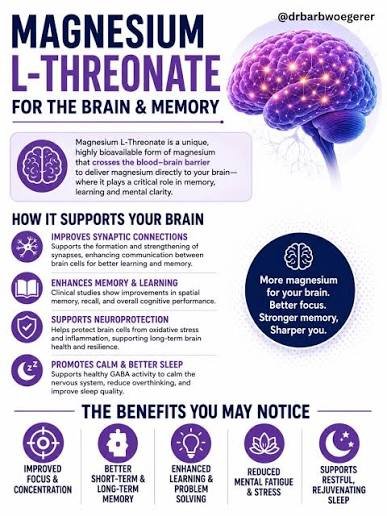
Magnesium L-Threonate is a relatively new form of magnesium developed through research at the Massachusetts Institute of Technology (MIT). It combines magnesium with L-threonic acid, a naturally occurring metabolite of vitamin C.
The goal was not simply to improve intestinal absorption but to develop a magnesium compound capable of increasing magnesium concentrations inside the brain. Animal studies provided the first evidence supporting this concept.
Researchers found that Magnesium L-Threonate increased brain magnesium levels more effectively than several conventional magnesium salts. This was associated with improvements in synaptic density, learning performance and memory in ageing animals. These findings generated considerable interest because increasing magnesium inside the brain had previously been difficult to achieve.
What Do Human Studies Show?
Animal research is encouraging, but human studies are ultimately more important. Several small clinical trials have evaluated Magnesium L-Threonate in older adults with cognitive concerns. Although results vary, many studies have reported improvements in certain measures of:
Working memory
Executive function
Attention
Processing speed
Some participants also reported better sleep quality and reduced anxiety, although these outcomes require further confirmation in larger studies. Importantly, researchers emphasise that the current evidence remains promising rather than definitive. Most trials have involved relatively small numbers of participants, and longer-term studies are still needed.
Nevertheless, Magnesium L-Threonate currently has the strongest body of research specifically focused on increasing brain magnesium levels and supporting cognitive function.
Magnesium Bis-Glycinate: An Excellent Choice for Stress and Sleep
While Magnesium L-Threonate has received attention for direct brain effects, Magnesium Bis-Glycinate remains one of the most widely recommended forms by clinicians.
In this formulation, magnesium is bound to the amino acid glycine, which itself functions as an inhibitory neurotransmitter within the central nervous system. Magnesium Bis-Glycinate is well absorbed and generally causes fewer digestive side effects than several other magnesium salts.
Although there is limited evidence that it raises brain magnesium levels to the same extent as Magnesium L-Threonate, it may support brain health indirectly by improving: Sleep quality, Relaxation, Stress management and Anxiety symptoms.
Since poor sleep and chronic stress can negatively affect concentration and memory, many individuals experience cognitive benefits after correcting magnesium deficiency with Magnesium Bis-Glycinate. For people whose primary concerns include insomnia, anxiety or chronic stress, it remains an excellent option.
What About Magnesium Citrate?
Magnesium Citrate is another highly bioavailable form that is commonly used to correct magnesium deficiency. Its strengths include:
Good intestinal absorption.
Wide availability.
Extensive clinical experience.
However, Magnesium Citrate has not been specifically developed for brain health, and relatively few studies have examined its direct effects on memory or cognition. For individuals with confirmed magnesium deficiency, it remains an effective supplement. However, if the primary goal is optimising cognitive performance, the scientific evidence currently favours Magnesium L-Threonate.
Is Magnesium Oxide a Good Choice?
Magnesium Oxide is one of the least expensive magnesium supplements available and is frequently included in multivitamin products. However, it also has one of the lowest absorption rates among commonly used magnesium salts.
Because relatively little elemental magnesium is absorbed, Magnesium Oxide is generally not considered the best option when the objective is supporting brain function. It is more commonly used as a laxative or for short-term digestive indications than as a premium magnesium supplement for cognitive health.
Key Points
-
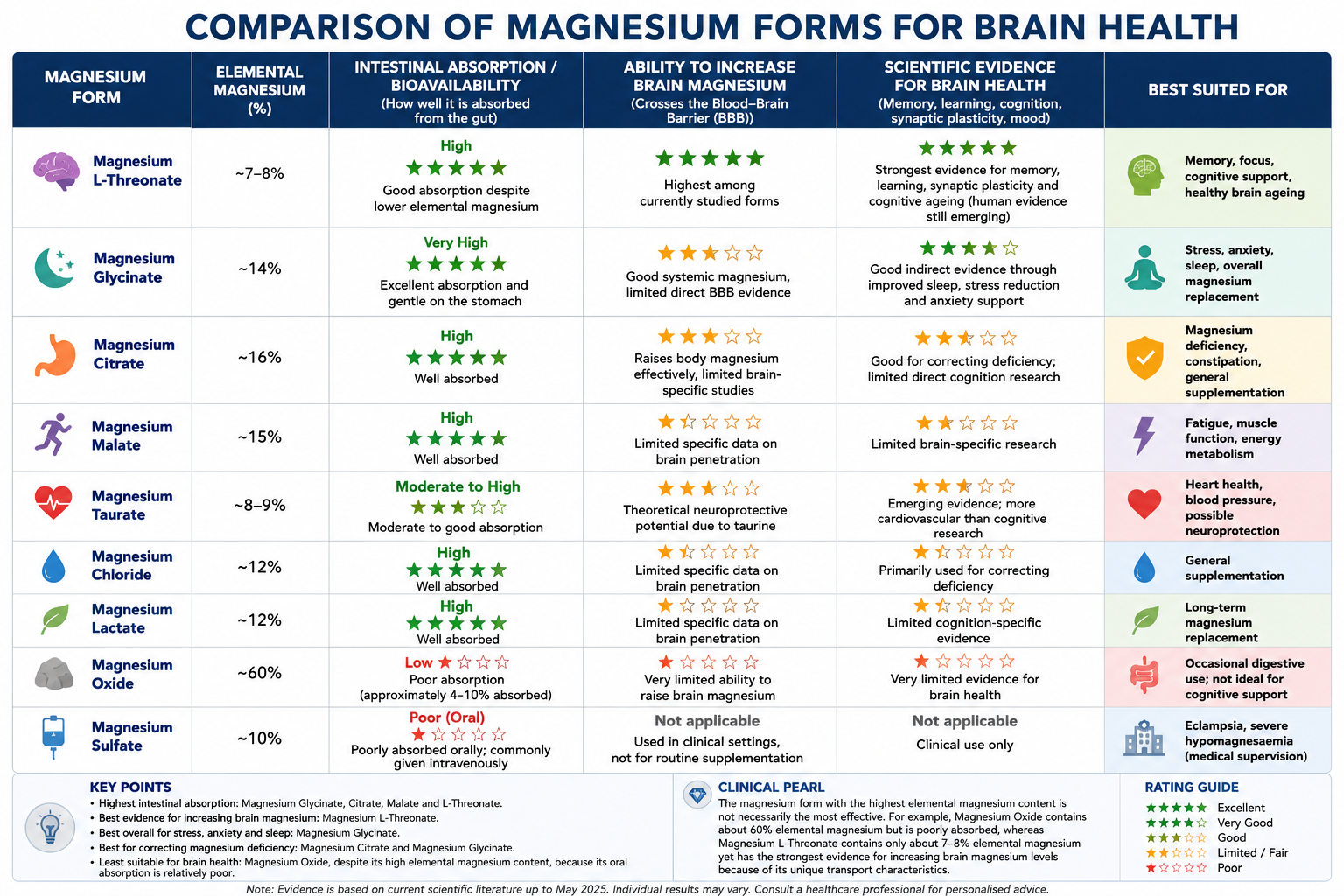
Highest intestinal absorption: Magnesium Bis-Glycinate, Citrate, Malate and L-Threonate – in that order
-
Best evidence for increasing brain magnesium: Magnesium L-Threonate
-
Best overall for stress, anxiety and sleep: Magnesium Bis-Glycinate
-
Best for correcting magnesium deficiency: Magnesium Citrate and Magnesium Bis-Glycinate
-
Least suitable for brain health: Magnesium Oxide, despite its high elemental magnesium content, because its oral absorption is relatively poor
Clinical Pearl: The magnesium form with the highest elemental magnesium content is not necessarily the most effective. For example, Magnesium Oxide contains about 60% elemental magnesium but is poorly absorbed, whereas Magnesium L-Threonate contains only about 7–8% elemental magnesium yet has the strongest evidence for increasing brain magnesium levels because of its unique transport characteristics.
Key Takeaways
Current scientific evidence suggests that Magnesium L-Threonate is the most promising form for supporting brain health because it appears to increase magnesium concentrations within the brain more effectively than conventional magnesium supplements. However, this does not mean it is automatically the best choice for everyone.
People struggling with poor sleep, chronic stress or anxiety may benefit greatly from Magnesium Bis-Glycinate, while those simply correcting magnesium deficiency can often achieve excellent results with Magnesium Citrate.
The most important message is that adequate magnesium status matters. Choosing the right formulation depends on your health goals, underlying deficiency, medical history and advice from your healthcare professional if he knows about this subject.
In Part 2 of this Series – we will review the human clinical trials in greater detail, compare Magnesium L-Threonate with other formulations using published research, discuss who may benefit most from supplementation and explain how to choose a high-quality magnesium supplement. You must choose Magnesium form only based on solid, scientific evidence, as its a matter of Grey Cells.
Select Scientific References
-
Slutsky I. et al. Enhancement of Learning and Memory by Elevating Brain Magnesium. Neuron
-
Liu G. et al. Magnesium L-Threonate and Cognitive Function: Human Clinical Studies
-
Gröber U., Schmidt J., Kisters K. Magnesium in Prevention and Therapy. Nutrients
-
Barbagallo M., Dominguez L.J. Magnesium and Healthy Ageing. International Journal of Molecular Sciences
-
National Institutes of Health (NIH). Magnesium Fact Sheet for Health Professionals
-
EFSA Panel on Nutrition. Dietary Reference Values for Magnesium