



Yet another key, path breaking article under our Evidence-Explained™ Series. This sure is going to a storm with “For or Against Statins” lobby. This challenges the long held (mis)conception that Lowering Cholesterol after 50 Years of Age is good for cardiac health. This write up demolishes this long held belief, with evidence, and demonstrates the cardio-protective effects of cholesterol. As always, don’t just follow this blindly, but do your own dilligence, please.
Cholesterol and Cardiovascular Diseases Risk
For decades, public health messages have reinforced a straightforward rule: lower cholesterol is always better. Yet, buried in the 1987 issue of the Journal of the American Medical Association (JAMA) is a 30-year follow-up from the Framingham Heart Study that challenges this simplified narrative.
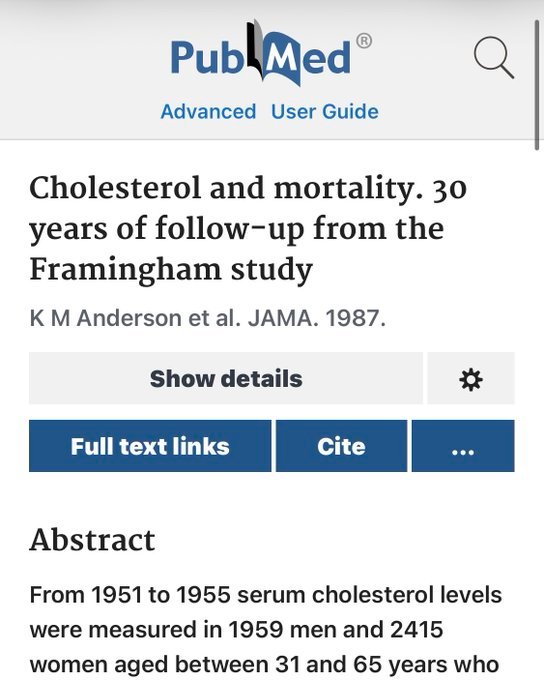
The paper, titled “Cholesterol and Mortality: 30 Years of Follow-up from the Framingham Study” (Anderson et al., 1987), documented a pattern that surprised researchers: among individuals over age 50, falling cholesterol levels were associated with higher overall and cardiovascular mortality, rather than lower.
Understanding why this phenomenon occurred—and how it was interpreted—provides important lessons for modern cardiology, particularly in India, where premature heart disease rates are among the highest globally.
What the 1987 Framingham Data Found
The Framingham Heart Study followed 1,959 men and 2,415 women aged 31 to 65 who were initially free of cardiovascular disease and cancer. Analyzing 30 years of data revealed distinct patterns based on age:

1. Under Age 50
In younger adults, total cholesterol levels were directly related to long-term mortality. For every 10 mg/dL increase in total cholesterol, overall mortality rose by 5%, and cardiovascular mortality rose by 9%. In this age bracket, lower cholesterol correlated with improved longevity.
2. After Age 50
For individuals over 50, total cholesterol levels no longer showed a direct association with overall mortality. Higher total cholesterol was not linked to increased death rates in this age group.
3. Spontaneous Drops in Cholesterol
When tracking changes over time, researchers observed that a spontaneous decline in total cholesterol over a 14-year period was associated with increased mortality over the subsequent 18 years. Specifically, each 1 mg/dL drop per year in total cholesterol was associated with an 11% increase in overall mortality and a 14% increase in cardiovascular mortality.

“Reverse Causation” Hypothesis: Why Was Cholesterol Dropping?
The finding that falling cholesterol was linked to higher mortality created a diagnostic puzzle. The study’s authors did not conclude that lowering cholesterol directly caused harm. Instead, they proposed an explanation known in epidemiology as reverse causation or confounding by subclinical disease:
“After age 50 years the association of mortality with cholesterol values is confounded by people whose cholesterol levels are falling—perhaps due to diseases predisposing to death.” — Anderson et al., JAMA (1987)
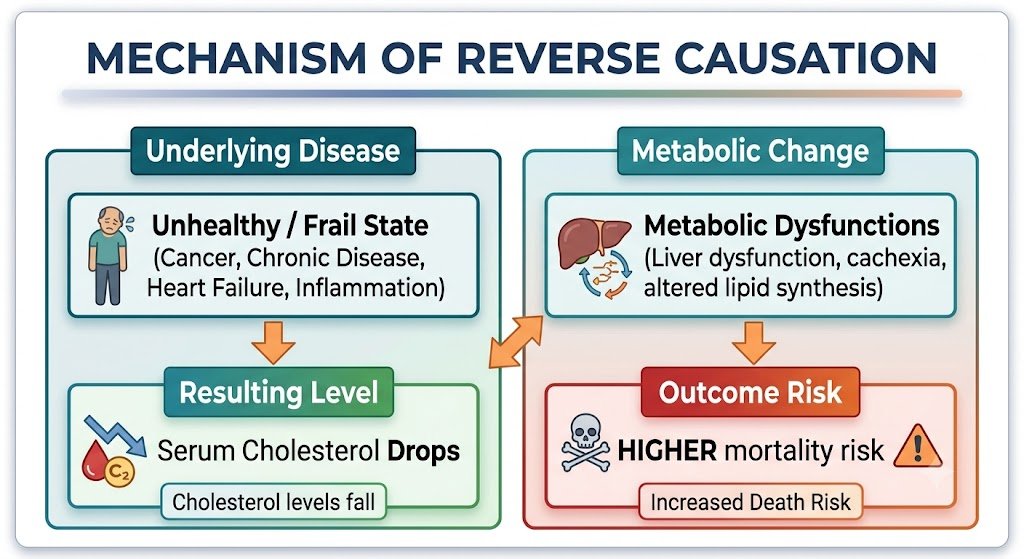
When severe illnesses develop—such as undiagnosed malignancies, end-stage heart failure, chronic liver dysfunction, or systemic inflammatory states—the body’s ability to synthesize and maintain cholesterol drops. In these cases, falling cholesterol is a marker of disease severity, not the primary driver of illness.
Pharmacological vs. Spontaneous Cholesterol Reduction
A critical distinction lies between spontaneous cholesterol loss caused by underlying disease and targeted pharmacological or dietary intervention:
-
Spontaneous Drops: Unintended drops in cholesterol often indicate underlying frailty, wasting, or chronic systemic disease
-
Targeted Reductions: Lowering atherogenic particles through lipid-lowering therapies (such as statins, ezetimibe, or PCSK9 inhibitors) or lifestyle modifications directly reduces the accumulation of plaque in arterial walls
How Clinical Targets Evolved Beyond Total Cholesterol
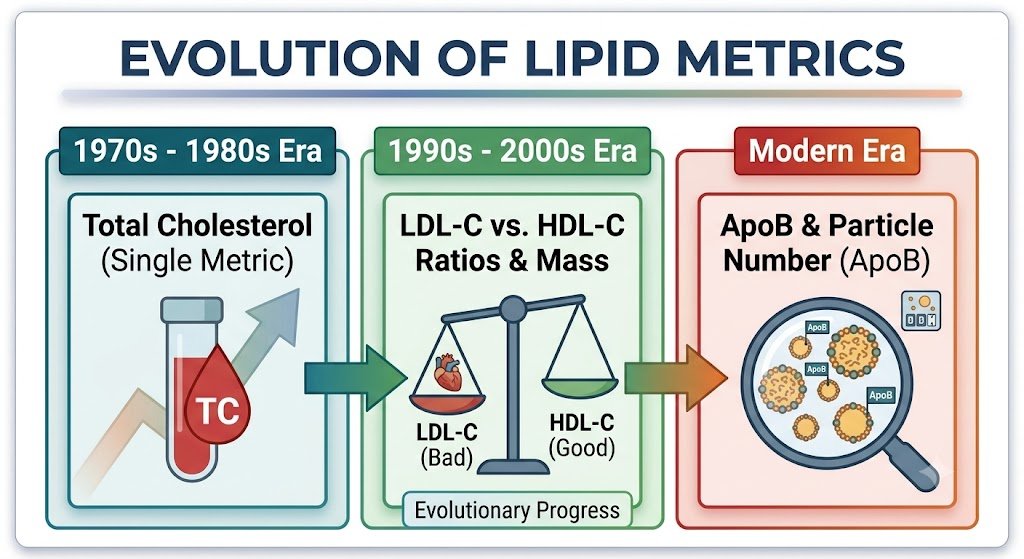
The 1987 Framingham paper highlighted the limitations of using Total Cholesterol as a sole diagnostic marker. Total cholesterol measures the combined mass of HDL (“good”), LDL (“bad”), VLDL, and triglycerides.
As cardiovascular science progressed, expert panels—including the National Cholesterol Education Program (NCEP) Expert Panels—focused on sub-fractions of cholesterol rather than total mass alone:
-
Total Cholesterol to LDL-C/HDL-C Split: Research demonstrated that high HDL cholesterol is protective, while high Low-Density Lipoprotein Cholesterol (LDL-C) promotes atherosclerosis. A high total cholesterol number driven entirely by high HDL carries a very different risk profile than one driven by high LDL-C
-
Standardized Clinical Guidelines: Organizations like the American College of Cardiology (ACC), American Heart Association (AHA), and Lipid Association of India (LAI) developed risk-stratified targets (such as LDL-C <70 mg/dL or <55 mg/dL for high-risk patients) based on randomized controlled trials rather than observational cohorts alone.
Indian Perspective: Why Lipid Interpretation Requires Nuance
For the South Asian population, the insights from lipid epidemiology carry specific clinical relevance. South Asians experience high rates of Premature Coronary Artery Disease (PCAD), often developing heart disease a decade earlier than Western populations.
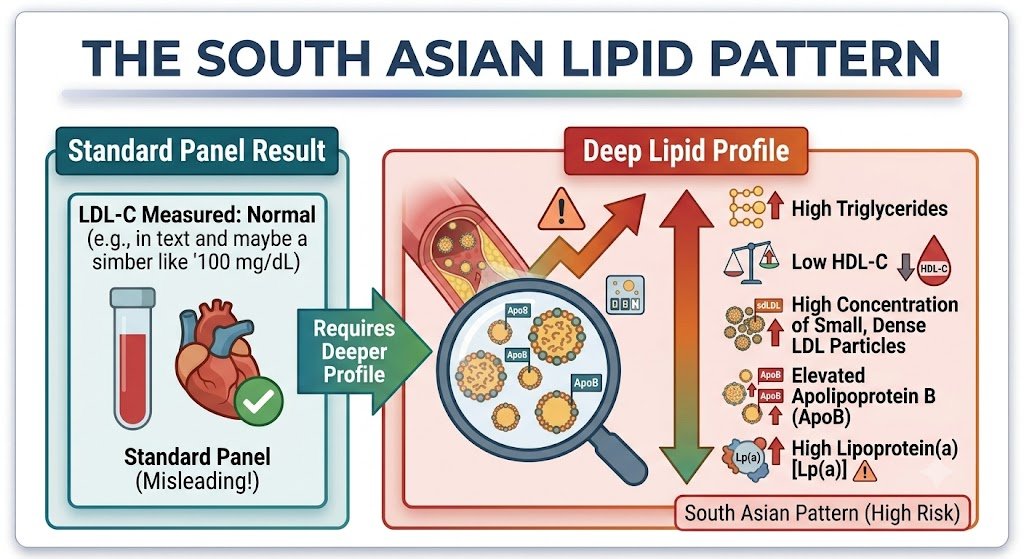
Standard lipid panels in Indian patients frequently show normal or low total cholesterol and LDL-C levels, while hiding significant underlying risk.
1. Atherogenic Dyslipidemia
South Asians commonly exhibit a metabolic triad: high triglycerides, low HDL-C, and an abundance of small, dense LDL (sdLDL) particles. Small, dense LDL particles carry less cholesterol cargo per particle, meaning an Indian patient can have a low LDL cholesterol mass reading despite carrying a high number of dangerous, plaque-forming particles
2. Total Particle Count (ApoB) Matters Most
Every atherogenic particle (LDL, VLDL, IDL, Lp(a)) carries exactly one molecule of Apolipoprotein B (ApoB). Measuring ApoB provides a direct count of circulating particles, overcoming the diagnostic blind spots of total cholesterol or calculated LDL-C
3. Contextualizing “Falling Cholesterol” in Indian Patients
When evaluating older Indian patients whose total cholesterol drops unexpectedly without medication or diet changes, clinicians should evaluate for underlying metabolic, gastrointestinal, or inflammatory conditions rather than assuming improved cardiovascular health
Key Takeaways for Patients and Clinicians
-
Context Matters: A spontaneous drop in total cholesterol in older adults can be a clinical sign of underlying illness and warrants medical evaluation
-
Total Cholesterol Is an Incomplete Metric: Total cholesterol alone does not capture cardiovascular risk. Modern cardiology evaluates specific sub-fractions like LDL-C, HDL-C, Non-HDL-C, and ApoB
-
Targeted Risk Reduction Works: Decades of randomized controlled trial data show that lowering atherogenic lipoproteins in high-risk individuals reduces the incidence of heart attacks and strokes
-
Comprehensive Evaluation for South Asians: Indian individuals should look beyond standard total cholesterol numbers and discuss advanced markers like ApoB, Lp(a), and HbA1c with their healthcare providers
Select References
-
Anderson, K. M., Castelli, W. P., & Levy, D. (1987). Cholesterol and mortality: 30 years of follow-up from the Framingham Study. JAMA, 257(16), 2176–2180. https://doi.org/10.1001/jama.1987.03390160062027
-
Puri, R., et al. (2020). Lipid Association of India Expert Consensus Statement on Management of Dyslipidemia in Indians 2020: Part III. Journal of the Association of Physicians of India, 68(11), 8–27.
-
Grundy, S. M., et al. (2019). 2018 AHA/ACC/AACVPR/AAPA/ABC/ACPM/ADA/AGS/APhA/ASPC/NLA/PCNA Guideline on the Management of Blood Cholesterol. Journal of the American College of Cardiology, 73(24), e285–e350.