



An India-focused, evidence-based examination of trans fats, heart attacks, diabetes, cancer and emerging health risks
Trans fats are not simply another unhealthy cooking oil. They are a distinct class of fatty acids with well-established adverse cardiovascular effects. For Indians, the distinction matters: the danger is not that all vegetable oils are harmful, but that certain industrially produced fats can substantially worsen the quality of the food supply.
Heart-health debate: sugar, omega-6 oils and trans fats
Sugar has attracted considerable attention in discussions about obesity, insulin resistance, type 2 diabetes and cardiovascular disease. Excessive intake of free sugars, particularly through sugar-sweetened beverages and highly processed foods, can contribute to excess energy intake, weight gain and metabolic dysfunction.
But what about dietary fats?
In recent years, soybean, corn, sunflower and other omega-6-rich vegetable oils have been portrayed as inherently inflammatory or damaging to the heart. Omega-6 fatty acids, especially linoleic acid, are being consumed increasingly by Indians.
Trans fats are different. Their molecular structure and metabolic effects distinguish them from the cis-unsaturated fatty acids naturally present in most non-hydrogenated vegetable oils. World Health Organization (WHO) identifies industrial trans fats as a major preventable dietary risk factor and recommends their elimination from the food supply.
The key question for India is therefore not whether all seed oils should be avoided. It is how much industrial trans fat remains in foods, how effectively regulations are enforced and how Indian consumers can identify and reduce exposure.
What exactly are trans fats?
Trans fatty acids are unsaturated fats containing at least one double bond in the trans configuration. They occur in two broad forms:
-
Industrial trans fats: Produced mainly through partial hydrogenation of vegetable oils, a process historically used to make liquid oils more solid, stable and suitable for commercial food production
-
Ruminant trans fats: Naturally present in smaller amounts in the milk, butter, ghee and meat of animals such as cows, buffaloes, sheep and goats, because of microbial activity in the rumen
Partially hydrogenated oils can contain very high proportions of trans fatty acids. WHO reports typical concentrations of around 25–45% in partially hydrogenated oils. These fats have historically been used in vanaspati, shortenings, bakery products, commercially prepared snacks and some fried foods.
High-temperature frying can also produce some trans fats, but WHO notes that this generally produces much smaller quantities than partial hydrogenation. Repeated heating and oil degradation are still important food-quality concerns, but they should not be confused with the industrial hydrogenation process.
Why trans fats are particularly harmful to the heart
The cardiovascular evidence is among the strongest reasons to prioritize trans-fat reduction.
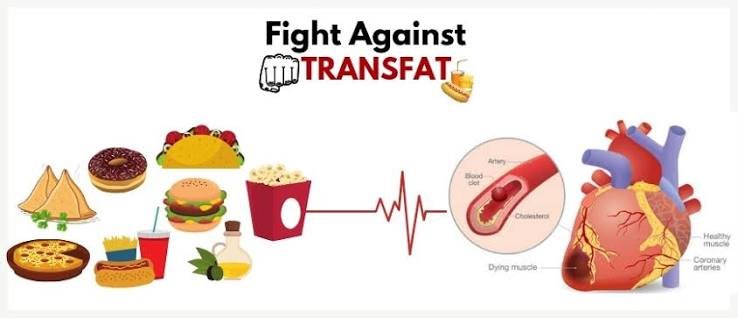
Trans fats adversely affect blood lipids by increasing LDL cholesterol and lowering HDL cholesterol. They can also contribute to endothelial dysfunction, inflammation and other processes associated with atherosclerosis.
WHO summarizes evidence indicating that higher trans-fat intake is associated with a 21% increase in coronary heart disease risk, a 28% increase in coronary heart disease mortality and a 34% increase in all-cause mortality. These are pooled estimates from international evidence, not India-specific risk estimates for an individual consumer.
The replacement nutrient also matters. Replacing trans fats with cis-unsaturated fats, such as those in non-hydrogenated vegetable oils, is expected to improve cardiovascular risk. Replacing them with refined carbohydrates or sugar does not necessarily deliver the same benefit.
India’s cardiovascular burden makes this a public-health priority
India faces a major burden of cardiovascular and metabolic disease. The ICMR-INDIAB national study, which included 113,043 participants across rural and urban India, estimated a weighted diabetes prevalence of 11.4%, prediabetes prevalence of 15.3%, hypertension prevalence of 35.5%, abdominal obesity prevalence of 39.5% and dyslipidaemia prevalence of 81.2%.
These figures describe overlapping metabolic risk conditions, not the proportion of disease caused by trans fats. Nevertheless, they show why improving the quality of dietary fats is relevant to Indian prevention strategies.
India’s dietary landscape is diverse. Household cooking may involve mustard, groundnut, soybean, sunflower, rice-bran or other oils, while commercial and festive foods can contain vanaspati, bakery shortening, butter or repeated-use frying oils. Exposure varies by region, income, food access, eating habits and the food businesses supplying the local market.
An Indian study examining food environments in rural villages and an urban slum found that commercially prepared snacks were an important source of trans-fat exposure. In that particular study, 84.3% of urban-slum households and 31% of rural households consumed snacks containing high trans-fat levels. The findings are historical and geographically limited; they should not be interpreted as current national prevalence. They nevertheless illustrate how food prepared outside the home can contribute to exposure that household cooking surveys may miss.
A separate analysis of 320 edible-oil and fat samples collected from 107 Indian sampling sites found that several vanaspati samples exceeded the then-applicable trans-fat limit.
The study also found considerable variation among oil types and samples. These results predate India’s current regulatory limits, but they helped demonstrate the importance of monitoring actual food composition rather than relying on product categories alone.
Trans fats and type 2 diabetes: a more nuanced evidence picture
Trans fats have been associated with insulin resistance and metabolic dysfunction in experimental and observational research. Proposed mechanisms include altered cell-membrane function, inflammation and changes in insulin-signalling pathways.
However, the relationship with the development of type 2 diabetes is less conclusive than the cardiovascular evidence. A pooled analysis of 12 prospective studies involving 25,126 participants, with 2,843 incident diabetes cases over a mean follow-up of 13.5 years, did not find significant associations between several measured trans-fat biomarkers and incident type 2 diabetes.
This does not establish that trans fats are metabolically harmless. It means that claims about directly causing diabetes require more careful consideration. The overall food pattern, energy balance, body fat distribution, physical activity, genetics and other dietary exposures influence diabetes risk.
For Indians, where diabetes and abdominal obesity are substantial concerns, reducing industrial trans fats is a sensible component of a broader dietary strategy. It should complement—not replace—attention to refined carbohydrates, excess calories, physical activity, sleep and clinical risk assessment.
Does trans-fat intake increase cancer risk?
The cancer evidence is emerging and remains less definitive than the evidence for cardiovascular harm.
A 2021 systematic review and meta-analysis included 46 observational articles examining dietary trans-fat intake and cancer risk. It reported positive associations for prostate cancer and colorectal cancer in pooled analyses. The review did not find statistically significant associations for breast cancer, ovarian cancer or non-Hodgkin lymphoma.
The authors also highlighted important limitations. Results differed by trans-fat subtype, study population and cancer site, and the available research could not reliably distinguish the effects of all individual trans-fat isomers.
Consequently, it would be inaccurate to say that trans fats are proven to cause cancer in humans across all cancer types. The findings justify further research, but they do not support assigning a specific cancer risk to an individual Indian consumer or estimating how many Indian cancer cases are attributable to trans fats.
For now, the most defensible public-health rationale for eliminating industrial trans fats remains their established cardiovascular harm. Potential cancer effects provide an additional research question, not the principal basis for dietary advice.
Fertility, pregnancy, autoimmune conditions and bone health: what is known?
Several additional health outcomes have attracted research interest, but evidence strength varies considerably.
Fertility: A prospective study of women investigating ovulatory infertility reported that replacing 2% of energy from carbohydrates with trans fats was associated with a 73% higher risk of ovulatory infertility. The association was also observed when trans fats replaced some unsaturated fats. This was an observational finding in a specific population, not an Indian clinical trial, and it requires replication.
Pregnancy outcomes: A 2026 systematic review and meta-analysis of 13 studies reported that biomarker-based evidence linked certain industrial trans-18:1 fatty acids with increased pre-eclampsia risk and indicators of reduced fetal growth. Dietary-intake studies were less consistent, while evidence concerning gestational diabetes and preterm birth remained limited. The authors emphasized the need for better prospective research
Bone health: A cross-sectional analysis of 4,022 US adults found inverse associations between plasma trans-fat concentrations and bone mineral density at several measured sites. However, it did not find significant differences in fracture prevalence across trans-fat quartiles. These findings are hypothesis-generating and cannot establish that trans-fat intake causes osteoporosis or fractures
Autoimmune disease: Inflammation and immune signalling are plausible pathways through which dietary fatty acids could influence immune function. However, the evidence identified here is insufficient to conclude that dietary trans fats cause autoimmune conditions such as rheumatoid arthritis, lupus or multiple sclerosis. Direct, well-designed human studies are needed.
India’s trans-fat regulation: progress and the remaining challenge
India has taken significant regulatory steps to reduce industrial trans fats. The Food Safety and Standards Authority of India (FSSAI) progressively tightened limits for trans fats in oils, fats and foods made using them.
From January 2022, the regulatory limit for industrial trans fats was reduced to not more than 2% by mass of the total oils or fats in the relevant food product. This is an important distinction: the limit is expressed relative to the total fat content, not as 2% of the food’s total weight.
FSSAI has also promoted awareness through initiatives such as its “Heart Attack Rewind” campaign and issued guidance on eliminating trans fats.
Regulation, however, is not identical to complete elimination. Monitoring needs to cover formal manufacturers as well as small bakeries, local sweet shops, street-food vendors and food-service businesses. Testing, traceability, ingredient reformulation and awareness among food operators remain important.
The regulatory ceiling also does not mean that every compliant product is equally healthy. A packaged snack may meet the trans-fat limit and still contain substantial sodium, refined starch, sugar or unsaturated fat. Overall dietary quality remains important.
What Indian consumers can do
Reducing trans-fat exposure does not require eliminating all cooking oils or traditional foods. Practical steps include:
-
Check ingredient lists: Avoid products listing partially hydrogenated oils or partially hydrogenated vegetable fats
-
Be mindful of bakery and fried foods: Commercial biscuits, samosa, vada pavs, medu-vadas, murukkus, pastries, puffs, shortenings and some fried snacks may warrant closer attention, especially where ingredient information is unavailable
-
Ask about fats used in food preparation: When practical, consumers can ask restaurants, bakeries and caterers whether they use vanaspati or partially hydrogenated fats
-
Choose non-hydrogenated oils appropriately: Ghee, Butter, Cold Pressed-Mustard, Coconut Oil and other Healthier oils can form part of a balanced diet. The choice should account for overall fatty-acid composition, cooking needs, cost and dietary pattern
-
Avoid repeated oil reuse: Repeated high-temperature use degrades frying oil and creates other undesirable compounds, even though this is not the same process as industrial partial hydrogenation
-
Focus on the complete dietary pattern: Vegetables, fruits, pulses, whole grains, nuts and appropriate animal protein sources matter alongside the type of cooking fat
WHO recommends keeping total trans-fat intake below 1% of total energy—less than 2.2 g per day for a 2,000-kcal diet—and advises that industrially produced trans fats should be avoided.
Takeaway: target trans fats, not all oils
Trans fats deserve serious attention because their cardiovascular harms are well established, they have no known health benefit and industrial sources can be replaced with healthier fats.
But the science does not support treating all omega-6-rich oils as equivalent to partially hydrogenated fats. Nor does it establish that trans fats are proven causes of every condition sometimes linked to them, including cancer, autoimmune disease, infertility and bone loss.
For India, the priority is clear: preserve progress in trans-fat regulation, strengthen surveillance of the food supply, improve consumer awareness and encourage healthier replacements in commercial food preparation.
The most useful heart-health message is eliminating industrial trans fats as a specific, evidence-backed target within a much broader effort to reduce cardiovascular and metabolic disease.