



The headline of this article maybe construed as an attemtp to try and scare Indians – and scared we all Indians must be of MASLD, a new emerging and potentially more troublesome condition for Indians. While Indians grappled with trio of Diabetes, CVDs and Hypertention, what with our dietary and lifestyle habits – MASLD has emerged as a serious healthcare scare that presents clear and present danger for Indians. Data from New Research just validates this point and some more…
Metabolic dysfunction-Associated Steatotic Liver Disease (MASLD)—formerly known as Non-Alcoholic Fatty Liver Disease (NAFLD)—has rapidly evolved from a niche hepatological concern into a premier public health crisis across the Indian subcontinent.
Historically viewed as a passive downstream complication of overt obesity and type 2 diabetes mellitus (T2DM), MASLD is now recognized as both an early driver and an independent manifestation of systemic metabolic failure.
MASLD – Incidence in Indians
Landmark data from the Phenome India Cohort (published in The Lancet Regional Health – Southeast Asia, February 2026) provides an urgent, comprehensive baseline regarding the true scale of hepatic steatosis and subclinical fibrosis in urban and semi-urban Indian populations.
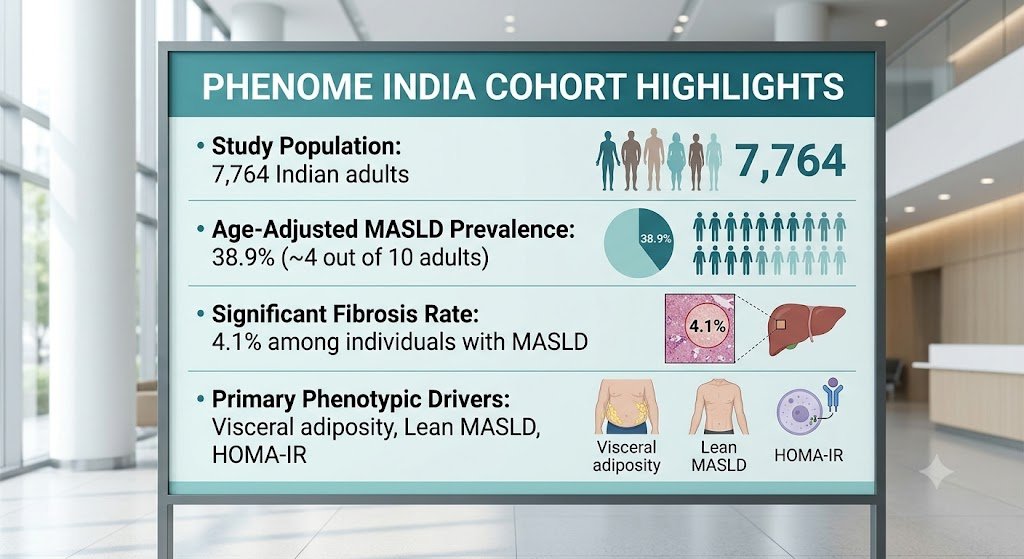
By analyzing 7,764 Indian adults, the cohort study revealed a staggering 38.9% age-adjusted MASLD prevalence, with 4.1% of MASLD individuals presenting with significant liver fibrosis.
Understanding these findings requires unpacking the unique South Asian metabolic phenotype, identifying the lifestyle drivers accelerating hepatic fat accumulation, and establishing actionable, evidence-based nutrition and clinical strategies tailored specifically for Indians.

Unpacking the Phenome India Cohort Data
The Phenome India study offers one of the most rigorously phenotyped epidemiological datasets on liver health in the country to date. Its findings shatter the historical misconception that liver disease in India is primarily driven by alcohol consumption or viral hepatitis.
Scale of the Problem
-
Near 40% Prevalence: An age-adjusted prevalence of 38.9% means that nearly 4 out of every 10 Indian adults carry excess intra-hepatic triglyceride accumulation. Translated across India’s vast adult population, this represents hundreds of millions of individuals at risk for progressive metabolic and cardiovascular deterioration.
-
Fibrosis Footprint: The finding that 4.1% of those with MASLD already exhibit significant fibrosis is clinically alarming. Liver fibrosis (specifically stages F2 and above) is the single strongest predictor of liver-related mortality, progression to cirrhosis, and hepatocellular carcinoma (HCC). This indicates that a vast sub-population of Indians is moving silently toward end-stage liver disease without displaying overt clinical symptoms.
-
Age-adjusted MASLD prevalence ranged from approximately 27% in Thiruvananthapuram to nearly 50% in Roorkee and Bhopal, while major metropolitan areas including Delhi, Bengaluru, Pune, Hyderabad and Chennai generally fell in the 37–42% range
South Asian Metabolic Phenotype: Why Indians Are Uniquely Vulnerable
The high burden of MASLD in India despite lower average Body Mass Index (BMI) cutoffs compared to Western populations highlights the South Asian Phenotype, characterized by:
-
High Visceral & Hepatic Fat at Low BMIs (“Lean MASLD”): Indians possess a marked propensity for central adiposity. Even when an individual appears “thin” by traditional BMI metrics (BMI < 23 kg/m²), ectopic fat preferentially deposits in the liver, pancreas, and deep abdominal visceral compartments
-
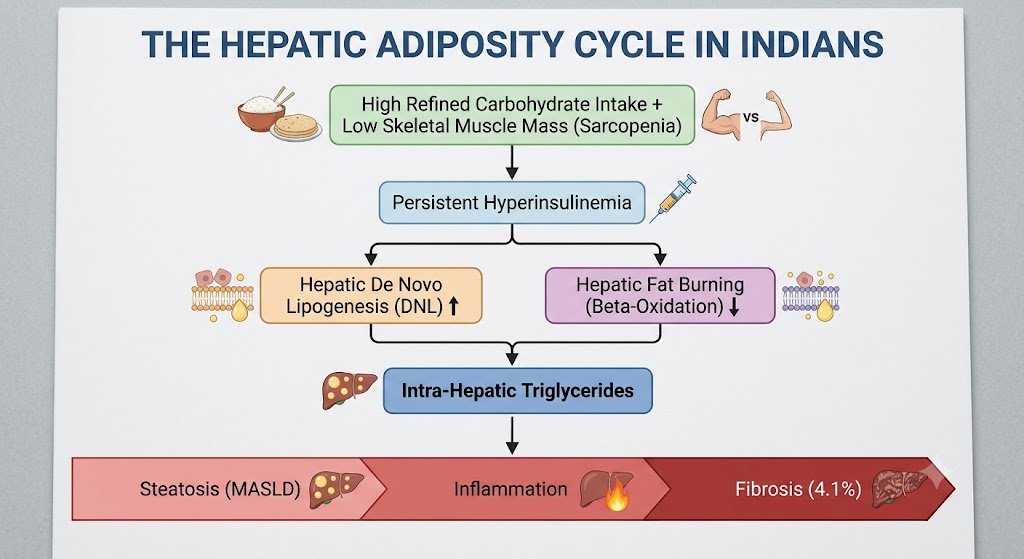
Accelerated Skeletal Muscle Loss (Sarcopenic Obesity): Skeletal muscle acts as the primary systemic sink for postprandial glucose disposal. The combination of low skeletal muscle mass (sarcopenia) and high visceral fat impairs glucose uptake, forcing excess circulating glucose to the liver, where it undergoes de novo lipogenesis (DNL)
-
Profound Baseline Insulin Resistance: Driven by high Homeostatic Model Assessment for Insulin Resistance (HOMA-IR) values, hyperinsulinemia suppresses hepatic beta-oxidation (fat burning) while upregulating fatty acid synthesis, effectively locking fat inside the liver cells (hepatocytes).
Key Dietary & Lifestyle Drivers in India
The sharp escalation of MASLD across India is rooted in modern nutritional shifts and sedentary habits:
-
Carbohydrate-Heavy Dietary Structure: Traditional and modern Indian diets typically derive 65% to 75% of total daily energy from carbohydrates, dominated by high-glycemic refined grains (white rice, polished wheat atta, maida). High glycemic loads cause rapid blood glucose surges, driving liver DNL
-
Fructose Overload: The widespread adoption of ultra-processed foods, sweetened beverages, packaged fruit juices, and commercial sweets introduces high amounts of free fructose. Fructose bypasses hepatic phosphofructokinase regulation, feeding directly into the liver’s lipogenic pathway
-
Industrial Seed Oils & Thermal Peroxidation: Diets high in oxidized, repeatedly heated cooking oils (rich in omega-6 linoleic acid) generate systemic lipid peroxides, accelerating hepatic inflammation (MASH – Metabolic dysfunction-Associated Steatohepatitis) and fibrogenesis
-
Sedentary Urbanization: Low physical activity combined with occupational sitting reduces muscle GLUT4 transporter expression, exacerbating insulin resistance
Evidence-Based Clinical Nutrition & Lifestyle Interventions for Indians
Reversing MASLD and arresting the progression to significant liver fibrosis requires a structured, multi-faceted metabolic approach.
A. Medical Nutrition Therapy (MNT) Strategies

B. Targeted Micronutrients & Nutraceuticals
-
Vitamin E (Full-Spectrum Mixed Tocopherols/Tocotrienols): Clinical guidelines recognize Vitamin E’s capability to diminish hepatic ballooning and inflammation. Use full-spectrum forms to protect hepatic membranes against lipid peroxidation
-
Omega-3 Fatty Acids (EPA/DHA): High-dose purified EPA/DHA (2 – 4 g/day) reduces liver triglyceride storage and downregulates lipogenic transcription factors (SREBP-1c)
-
Choline & Betaine: Choline is an essential component of Very Low-Density Lipoprotein (VLDL), required to export triglycerides out of the liver. Supplementing choline or betaine helps clear trapped hepatic fat
-
Bioactive Botanicals: Standardized extracts of Curcumin (enhanced bioavailability) and Silymarin (Milk Thistle) reduce hepatic oxidative stress and inflammatory signaling pathways (NF-kappa Beta)
C. Exercise & Chrono-Nutrition Protocols
-
Resistance Training (3-4x/week): Building skeletal muscle mass increases the body’s glucose storage capacity, blunting hepatic lipogenesis independent of weight loss
-
Post-Meal Walking: A brisk 10 to 15-minute walk immediately following major meals significantly lowers postprandial glucose and triglyceride peaks
-
Time-Restricted Eating (TRE): Implementing an 8 to 10-hour daytime eating window (e.g., 9:00 AM to 6:00 PM) allows extended overnight fasting, lowering basal insulin levels and promoting hepatic autophagy (cellular cleanup of damaged organelles and lipids)
Early Screening & Public Health Roadmap
To mitigate the rising tide of liver fibrosis identified in the Phenome India cohort, clinical practice in India must shift from reactive management to early, universal screening:
-
Move Beyond Standard Liver Function Tests (LFTs): Normal ALT/AST levels frequently miss active MASLD and early fibrosis. Clinicians must adopt routine non-invasive risk calculators like the FIB-4 Index (combining age, AST, ALT, and platelet count)
-
Routine Transient Elastography (FibroScan): Individuals with T2DM, abdominal obesity, or high FIB-4 scores should undergo elastography to measure liver stiffness (fibrosis) and Controlled Attenuation Parameter (CAP, steatosis)
-
Policy-Level Dietary Reform: Public health campaigns must address the over-consumption of refined carbohydrates and hidden sugars, promoting traditional regional diets rich in fiber, pulses, and healthy fats
Conclusion
The Phenome India cohort study acts as a critical wake-up call. With an age-adjusted MASLD prevalence of 38.9% and 4.1% displaying significant fibrosis, liver disease can no longer be treated as an isolated organ issue—it is a central pillar of India’s broader metabolic disease crisis.
By combining early screening, targeted dietary restructuring, muscle preservation, and lifestyle interventions, India can halt the progression of MASLD, protecting millions from liver failure and cardiometabolic disease.
For India’s growing diabetes and obesity epidemic, MASLD may therefore be one of the most important—and most under-recognised—early warning signs of systemic metabolic disease.
Key references
-
Arvind M, Verma A, Raj K S, et al. Burden of MASLD and liver fibrosis: evidence from Phenome India cohort. The Lancet Regional Health – Southeast Asia. 2026;45:100723
-
Shalimar, Elhence A, Bansal B, et al. Prevalence of Non-alcoholic Fatty Liver Disease in India: A Systematic Review and Meta-analysis. Journal of Clinical and Experimental Hepatology. 2022;12:818–829
-
Anjana RM, et al. Metabolic non-communicable disease health report of India: the ICMR-INDIAB national cross-sectional study. The Lancet Diabetes & Endocrinology. 2023
-
EASL–EASD–EASO. Clinical Practice Guidelines on the Management of MASLD. Journal of Hepatology