



As Indian grapple with increased risk of metabolic disorders such as Diabetes and MASLD / NAFLD (Metabolic Dysfunction Associated Fatty Liver Disease) – we share details on a few risk scores which are pertinent and relevant for Indians and can be used at home. Some of these do not require any blood tests, however, some do require specific blood tests before using these risk calculators.
Disclaimer – These risk calculators are strictly and only for educational screening and risk-assessment, based on published clinical algorithms. These are not diagnostic tests and cannot confirm or exclude diabetes, MASLD/fatty liver disease, liver fibrosis or any other medical condition. Results should be interpreted in the context of your medical history and, where appropriate, confirmed with laboratory testing, imaging and/or assessment by a qualified healthcare professional. Do not start, stop or change any medication or supplements based solely on these results.
Risk Calculators
Risk scores are mathematical formulas that combine specific patient measurements, lab results and / or clinical features to estimate the statistical probability of developing a disease or having an advanced stage of a condition. These risk scores, however, do not replace thorough diagnostics and consultations with Healthcare Providers.
Clinically validated risk scores help evaluate the probability of developing Type 2 Diabetes Mellitus (T2DM) and Non-Alcoholic Fatty Liver Disease (NAFLD / MASLD).
Due to the distinct “Asian Indian Phenotype” (higher body fat and abdominal adiposity at lower Body Mass Index [BMI] levels), global calculators like the Western BMI charts often underestimate risk for South Asians.
The four clinical formulas below range from non-invasive home-based questionnaires to blood-test based laboratory indexes.
Formula 1: Indian Diabetes Risk Score (IDRS)
-
Target Condition: Undiagnosed Type 2 Diabetes / Prediabetes
-
Validation Status: Developed and clinically validated by the Madras Diabetes Research Foundation (MDRF). It is widely used across Indian primary healthcare settings.
-
Requirements: Measuring tape, no blood test needed.
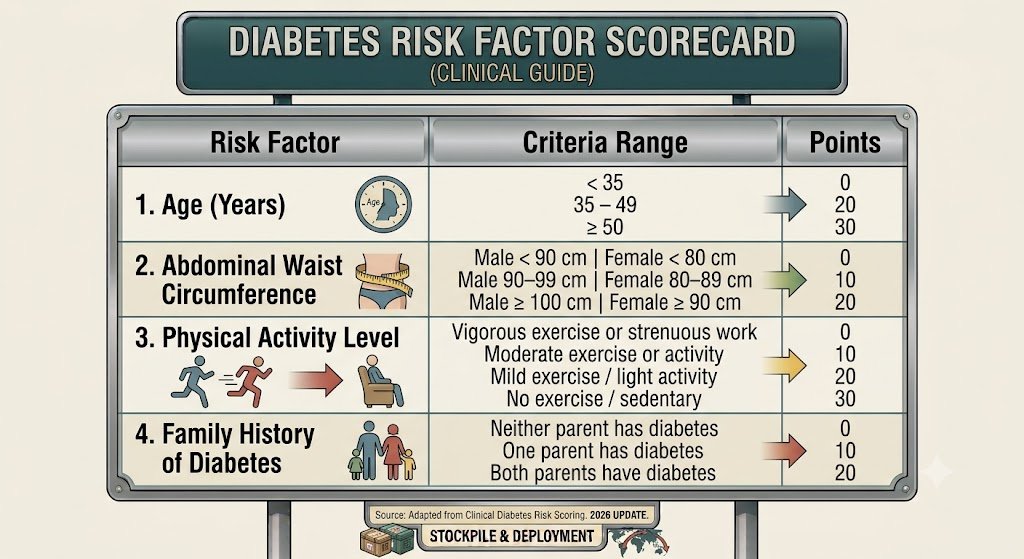
Risk Interpretation
-
Total Score < 30 (Low Risk): Low probability of undiagnosed diabetes. Maintain active lifestyle
-
Total Score 30 – 50 (Moderate Risk): Moderate probability. Targeted screening recommended
-
Total Score ≥ 60 (High Risk): High Probability. A clinical blood test (Fasting Blood Sugar & HbA1c) is strongly advised
Formula 2: Hepatic Steatosis Index (HSI)
-
Target Condition: Non-Alcoholic Fatty Liver Disease (Steatosis)
-
Validation Status: Clinically validated cross-sectionally; widely applied in Indian clinical trials alongside abdominal ultrasound.
-
Requirements: Routine Liver Function Test (ALT and AST enzymes) & Height/Weight.
Mathematical Equation
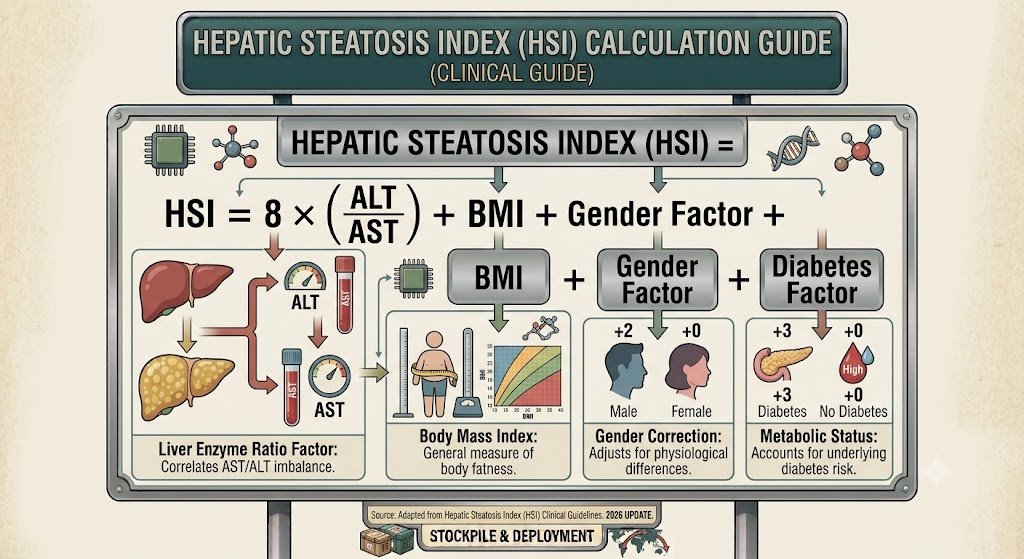
- ALT / AST: The ratio of alanine aminotransferase to aspartate aminotransferase from a blood test
- BMI: Body mass index. You can calculate your BMI by Dividing Your Weight in Kg by Sq. Root of Your Height in Meters
- Sex: Add 2 points if the patient is female and 0 points for Male
- Diabetes: Add 2 points if the patient has type 2 diabetes and 0 points if no diabetes
Calculation Example
-
Subject: 45-year-old male with Type 2 Diabetes, Weight = 78 kg, Height = 1.70 m (BMI = 26.99).
-
Lab Values: ALT = 45 U/L, AST = 30 U/L; (ALT / AST = 1.5)
-
Formula: HSI = (8 X 1.5) + 26.99 + 0 + 2 = 12 + 26.99 + 2 = 40.99
Cut-Off Values
-
HSI < 30.0: Fatty liver rule-out (Low probability)
-
HSI 30.0 – 35.9: Intermediate zone (Inconclusive)
-
HSI ≥ 36.0: High Probability of Fatty Liver. An abdominal ultrasound or FibroScan is recommended
Formula 3: Lipid Accumulation Product (LAP Index)
-
Target Condition: Visceral Fat Overload, Insulin Resistance & NAFLD Risk
-
Validation Status: Clinically validated surrogate marker for metabolic syndrome and hepatic steatosis in South Asian populations.
-
Requirements: Measuring tape (Waist) & Fasting Lipid Profile (Triglycerides)
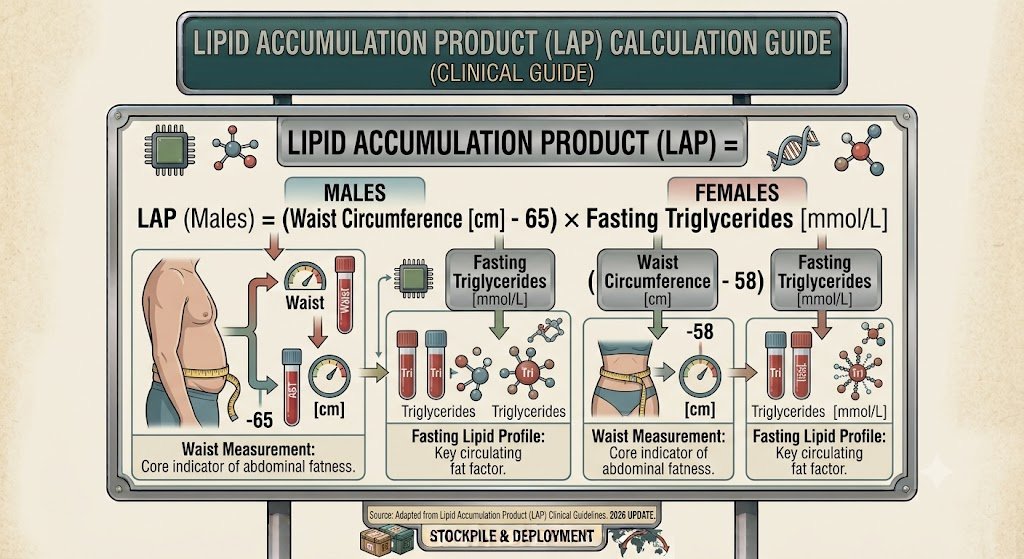
Note: To convert Triglycerides from mg/dL to mmol/L, divide by 88.57)
Cut-Off Values (South Asian Adapted)
-
Males: LAP values > 30–35 indicate elevated visceral adiposity, higher risk of insulin resistance, and hepatic steatosis
-
Females: LAP values > 22–27 indicate elevated risk
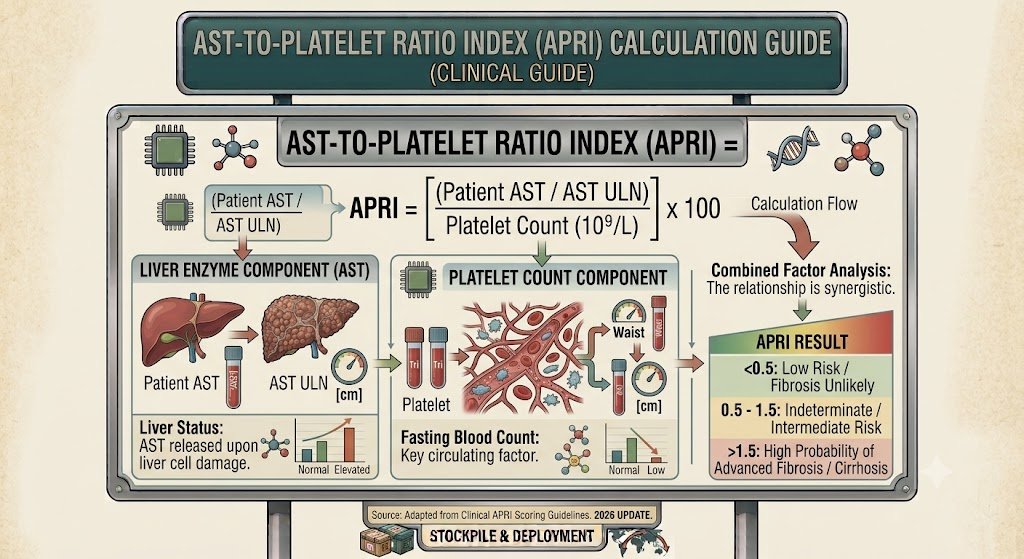
Formula 4: AST-to-Platelet Ratio Index (APRI)
-
Target Condition: Screening for Advanced Liver Fibrosis / Scarring
-
Validation Status: Endorsed by the World Health Organization (WHO) and Indian Society of Gastroenterology as an initial non-invasive marker for liver fibrosis.
-
Requirements: Liver Function Test (AST), Complete Blood Count (Platelet count), and laboratory Upper Limit of Normal (ULN) for AST (typically ~40 U/L).
Mathematical Equation
Cut-Off Values
-
APRI < 0.5: Low risk of significant liver fibrosis
-
APRI 0.5 – 1.0: Indeterminate zone; moderate risk
-
APRI > 1.0: High probability of significant fibrosis; warrants specialized consultation with a Gastroenterologist/Hepatologist
Step-by-Step Clinical Worked Example
Patient Profile
-
Age & Sex: 45-Year-Old Male
-
Clinical Context: Evaluated for Metabolic Dysfunction-Associated Steatotic Liver Disease (MASLD / Fatty Liver)
Laboratory Inputs
-
Serum AST Level: 68 U/L (Elevated)
-
Laboratory AST ULN Baseline: 40 U/L
-
Platelet Count: 135 X 10^9 (135,000/μL) (Mildly Reduced / Mild Thrombocytopenia)
Detailed Calculation
-
Calculate the Normalized AST Ratio:
Divide the patient’s AST level by the laboratory’s Upper Limit of Normal:
AST Ratio = 68 / 40 U/L = 1.70 -
Divide by the Platelet Count:
Intermediate Value = 1.70 / 135 = 0.01259259 -
Scale by 100 to get the Final APRI Score:
APRI = 0.01259259 X 100 = 1.26
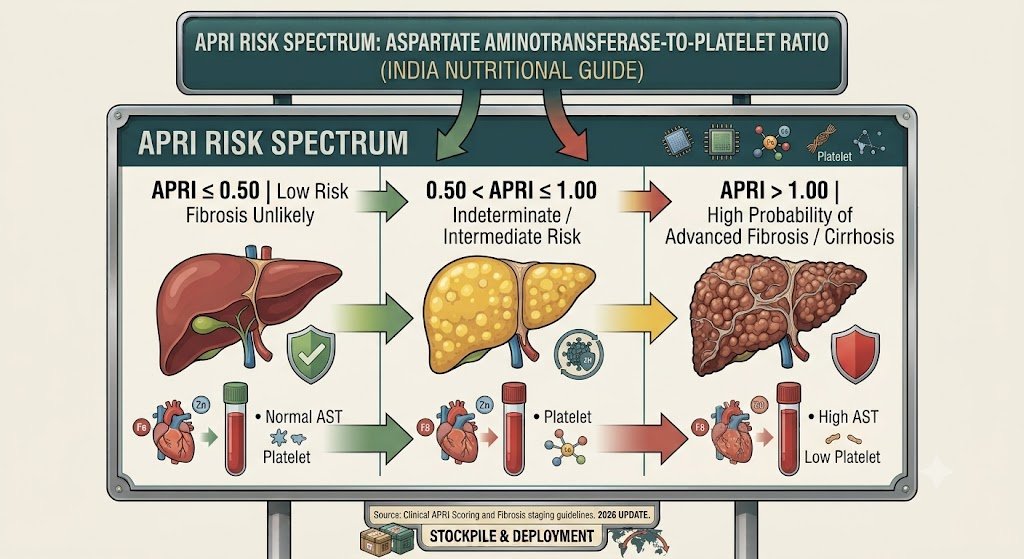
Score Range |
Clinical Interpretation |
Recommended Action |
APRI <0.50 |
Low Risk of significant liver fibrosis (high negative predictive value) |
Maintain lifestyle interventions; re-screen periodically |
> 0.50 – 1.00 |
Intermediate Risk; potential moderate fibrosis (F ≥ 2) |
Secondary non-invasive test recommended (e.g., FIB-4 or Transient Elastography/FibroScan) |
APRI > 1.00 |
High Risk of advanced fibrosis (F3/F4) or early cirrhosis |
Referral to a Hepatologist for FibroScan, advanced imaging, or liver biopsy |
Final Verdict for Example Patient: With an APRI score of 1.26 (which exceeds the 1.00 threshold), this 45-year-old male shows a high probability of advanced liver fibrosis. Clinical guidance warrants prompt follow-up with a gastroenterologist or hepatologist for confirmation via Transient Elastography (FibroScan) or specialized liver imaging.
Important Medical Disclaimers
These calculators are screening tools ONLY and are by no means any diagnostic tests. These calculators cannot and should not replace:
-
Fasting blood glucose or HbA1c tests (for diabetes diagnosis)
-
Liver ultrasound or FibroScan (for fatty liver diagnosis)
-
Physician consultation and clinical examination
-
False negatives possible: Some people with normal scores may still have diabetes or fatty liver. Regular health checkups are essential
-
Consult your doctor before making any lifestyle or medication changes based on any of these scores
Clinical & Diagnostic References
-
Mohan, V., et al. (2005). A simple Indian Diabetes Risk Score (IDRS) for screening of undiagnosed diabetic subjects in India. The Journal of the Association of Physicians of India (JAPI), 53, 759-763
-
Lee, J. H., et al. (2010). Hepatic steatosis index: a simple screening tool for nonalcoholic fatty liver disease. Digestive and Liver Disease, 42(7), 503-508
-
Kahn, H. S. (2005). The “lipid accumulation product” performs better than body mass index for recognizing cardiovascular risk. BMC Cardiovascular Disorders, 5(1), 26
-
Wai, C. T., et al. (2003). A simple noninvasive index can predict both significant fibrosis and cirrhosis in patients with chronic hepatitis C. Hepatology, 38(2), 518-526