



In modern society, sitting has become the default physical human state. From the morning commute to eight hours at an office desk, followed by evening relaxation on the couch, the average adult spends the vast majority of their waking hours completely sedentary.
Today, the average person spends hours sitting at a desk, staring at screens, commuting in vehicles, scrolling on phones, sleeping less, eating more processed food, and moving far less than previous generations. This mismatch between how our bodies evolved and how we now live is one of the biggest reasons behind the rise in chronic pain, lifestyle disorders, mental fatigue, and musculoskeletal problems.
While public health messaging has long emphasized the benefits of deliberate exercise—such as jogging, swimming, or weightlifting—a rapidly growing body of epidemiological and physiological evidence highlights a distinct, parallel danger: the total volume and uninterrupted duration of daily sitting.
Dangers of Prolonged Sitting – New Eidence
Last Seventy to One Hundred Years, technology has transformed how we live and work. While innovation has made life more efficient, it has also made us dangerously inactive.
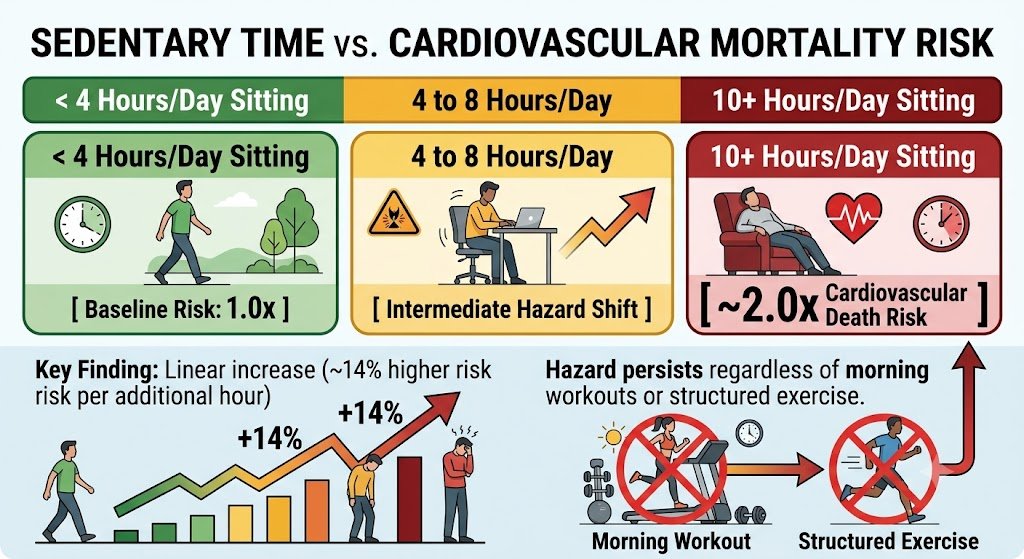
A landmark 2024 meta-analysis published in Preventive Medicine pooled data from 17 prospective cohort studies encompassing more than 800,000 adults. The findings delivered a stark wake-up call to the global medical community: every additional hour of daily sitting increases the risk of cardiovascular disease (CVD) mortality by approximately 14%.
Crucially, the relationship between sitting and cardiovascular death is linear—there is no observed “safe floor”. People who sit for 10 or more hours per day face nearly twice (2X) the risk of dying from cardiovascular disease compared to those who sit for fewer than four hours daily. Most alarming of all, this risk persists even after statistical adjustment for age, smoking status, dietary quality, and—most surprisingly—regular physical exercise.
You cannot out-run, out-swim, or out-gym an eight-hour daily desk habit. The chair itself is an independent physiological risk factor, and standing up is the most accessible medicine available.
2024 Meta-Analysis: Unpacking the 800,000-Person Study
For years, researchers debated whether sedentary behavior was simply the absence of exercise or an independent pathophysiological hazard. The 2024 meta-analysis in Preventive Medicine definitively resolved this question.
“Active Couch Potato” Phenotype
One of the study’s most critical findings is what researchers call the “Active Couch Potato” paradox. Many individuals believe that completing a 45-minute high-intensity workout in the morning grants them immunity from the metabolic consequences of sitting for the remaining 10 to 12 hours of the day.
The data proves otherwise:
-
Structured physical activity increases cardiorespiratory fitness (VO2 max) and builds muscle tissue
-
However, prolonged, unbroken sitting shuts down cellular signaling pathways in major postural muscles, neutralizing many of the acute metabolic benefits gained during morning exercise
-
As a result, an individual who exercises for 45 minutes but sits for 9 hours remains at a significantly elevated risk for cardiovascular mortality compared to an individual who moves intermittently throughout the day
Acute Physiology: What Happens inside the Body During 60 Minutes of Sitting?
To understand why sitting is so damaging, we must look at the immediate biochemical changes that occur within minutes of sitting down.
The human body evolved for near-constant low-intensity movement (walking, foraging, standing). When you sit, postural muscles—specifically the large weight-bearing muscles of the legs, glutes, and lower back—go completely silent.
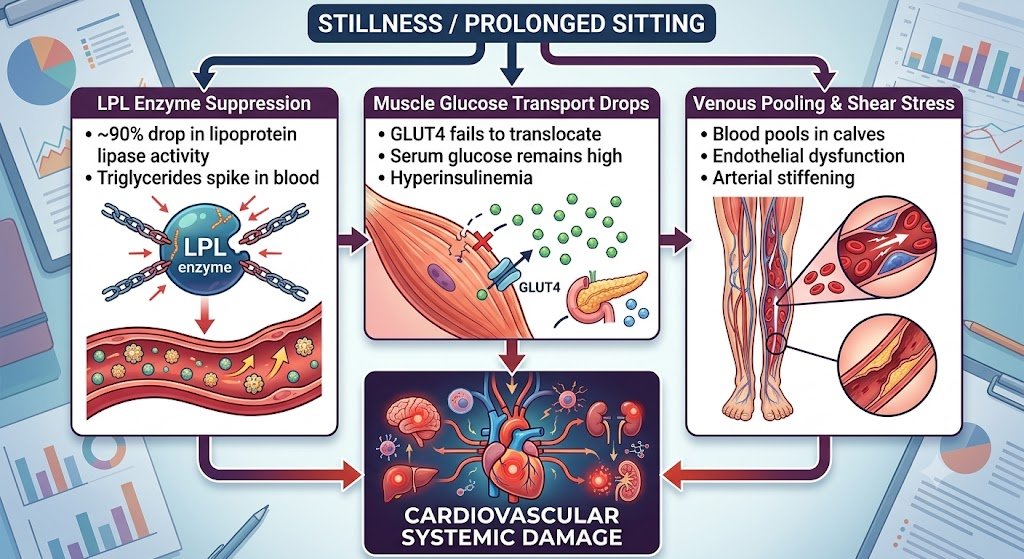
A. Lipoprotein Lipase (LPL) Suppression
Lipoprotein Lipase (LPL) is a crucial enzyme located on the endothelial walls of blood capillaries. Its job is to break down circulating triglycerides and blood fats, converting them into free fatty acids for energy or storage.
-
Within minutes of sitting down, LPL activity in lower-limb postural muscles drops by up to 90%
-
Without active LPL, circulating blood fats remain elevated for hours after a meal, leading to lipid deposition on arterial walls, systemic low-grade inflammation, and accelerated atherosclerosis
B. Blunted Glucose Uptake & Hyperinsulinemia
When muscles contract (even during simple standing or light stepping), they transport glucose out of the bloodstream via non-insulin-dependent GLUT4 translocation.
-
When you sit still, GLUT4 translocation halts in your lower body
-
Blood glucose levels stay elevated after meals, forcing the pancreas to secrete higher levels of insulin. Over years, this chronic postprandial hyperglycemia and hyperinsulinemia damages arterial linings, increases arterial stiffness, and lays the groundwork for Type 2 Diabetes and endothelial dysfunction
C. Venous Pooling and Endothelial Shear Stress
Gravity continuously pulls blood toward the lower extremities. Walking acts as a secondary heart: every step contracts the calf muscle pump, forcing venous blood back up to the heart.
-
Prolonged sitting causes blood to pool in the lower legs and calves.
-
This pooling reduces blood flow velocity through the femoral and popliteal arteries, drastically lowering arterial shear stress—the mechanical friction of blood moving against vessel walls
-
Healthy shear stress stimulates the production of Nitric Oxide (NO), a critical compound that relaxes blood vessels and prevents clotting. Low shear stress causes vessels to constrict, hardens arterial walls, and increases blood pressure
Total Sitting vs. Unbroken Sitting: The Columbia University Breakthrough
While total daily sitting duration dictates long-term overall risk, how that sitting time is accumulated is equally important. A pivotal 2017 clinical study from Columbia University (published in the Annals of Internal Medicine) followed nearly 8,000 adults using accelerometers.
The researchers discovered that individuals who accumulated sitting time in long, uninterrupted stretches (30 to 60+ minutes) had the highest mortality rates, regardless of their total sitting time. Conversely, individuals who broke up their sitting every 30 minutes exhibited significantly lower risk profiles.
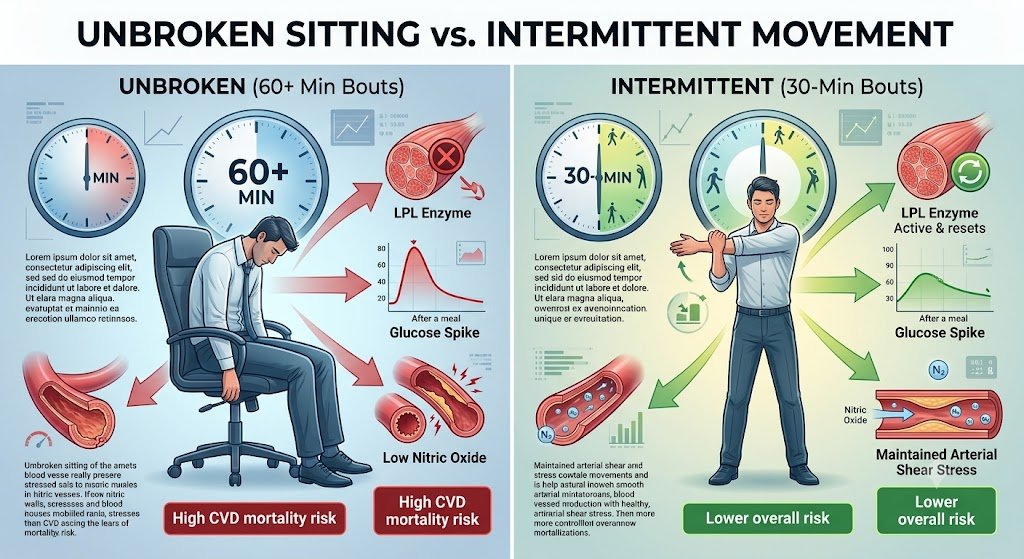
The 2024 meta-analysis reinforced these findings: total sitting time and unbroken sitting duration act as twin accelerometers for cardiovascular risk. Even if your job requires a total of 8 to 10 hours of desk time, breaking that time into small, frequent chunks mitigates a major portion of the biological damage.
Solution: Standing and Micro-Breaks as Medicine
Reversing the cardiovascular harm of prolonged sitting does not require intense, exhausting workouts throughout the day. The physiological trigger required to reactivate LPL enzymes, restore blood flow, and clear glucose is remarkably small: simply breaking up stillness by standing up or taking light movement breaks.
The 30-Minute Micro-Break Protocol
-
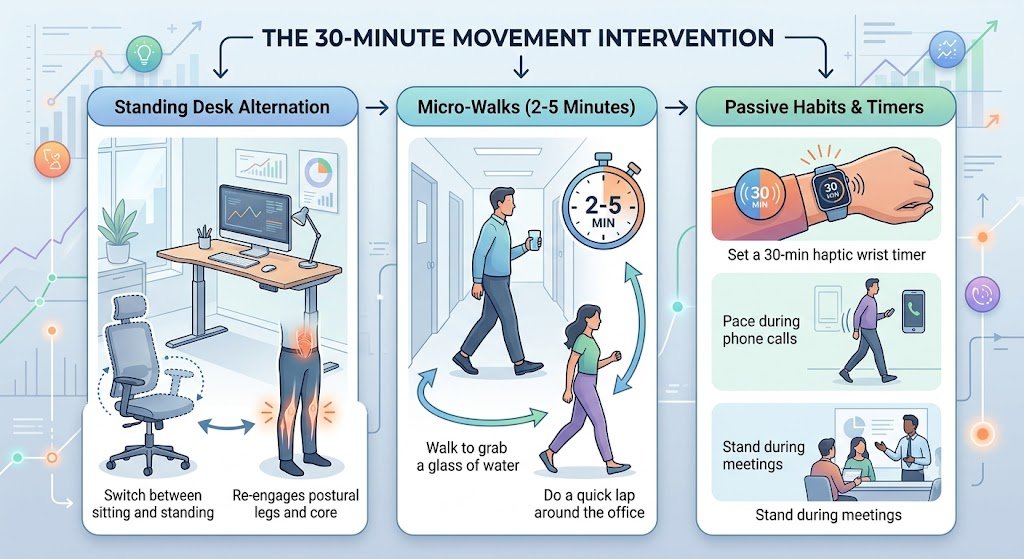
Set a Silent 30-Minute Timer: Use a smartwatch, phone alarm, or desktop app to signal the end of a 30-minute sitting block
-
Execute a 2-Minute Movement Break: When the timer goes off, stand up immediately. You do not need to perform burpees or sweat. Simple effective options include:
-
Walking to get a glass of water
-
Walking a lap around your office or home
-
Performing 10 to 15 bodyweight calf raises or air squats at your desk
-
-
Use a Sit-Stand Desk Dynamic: If using a standing desk, alternate between 30 minutes of sitting and 30 minutes of standing. Standing alone engages core and leg musculature, doubling caloric burn and maintaining baseline vascular tone compared to sitting
-
Pace During Phone Calls: Convert audio calls or virtual meetings into standing or pacing opportunities
Comparative Metabolic Impact
To see how simple interventions mitigate sitting risk, consider the metabolic comparison between continuous sitting, workout-only routines, and structured micro-breaks:
Parameter |
Continuous Sitting (8+ Hours) |
Morning Workout + Continuous Sitting |
30-Minute Intermittent Movement Breaks |
LPL Enzyme Activity |
Suppressed by up to 90% all day |
Temporarily elevated, then suppressed for rest of day |
Sustained baseline activation throughout the day |
Postprandial Glucose Clearance |
Poor; prolonged high spikes |
Moderate clearance post-workout, poor post-meal |
Significantly improved; continuous GLUT4 activity |
Femoral Artery Flow & Shear Stress |
Severely reduced; blood pooling |
Temporary surge, long periods of stagnation |
Maintained; periodic calf-pump activation |
Long-Term Cardiovascular Mortality Risk |
Highest (~2.0x baseline at 10+ hrs) |
Moderate-High (Exercise reduces, but does not eliminate risk) |
Substantially lower overall hazard profile |
Conclusion
The findings of the 2024 meta-analysis in Preventive Medicine represent a paradigm shift in how we think about exercise, sedentary behavior, and cardiovascular health. Health is not defined solely by what you do during a single hour at the gym; it is profoundly shaped by what your body does during the remaining 15 waking hours.
Prolonged, unbroken sitting treats the cardiovascular system to continuous biochemical stress: enzyme shutdown, glucose stagnation, lipid buildup, and arterial constriction.
The intervention is small, free, and accessible to everyone. You do not need expensive equipment or an aggressive fitness routine to start reducing your risk today. Set a timer every 30 minutes, stand up, take a lap, get a glass of water, and move. Over 800,000 people and 17 studies confirm: the chair is the risk, and standing up is the medicine.
Key Scientific References
-
Zhou, X., et al. (2024). Sedentary time and cardiovascular disease mortality: A systematic review and meta-analysis of prospective cohort studies. Preventive Medicine, 178, 107821. [PubMed ID: 38081421]
-
Diaz, K. M., et al. (2017). Patterns of Sedentary Behavior and Mortality in U.S. Middle-Aged and Older Adults: A National Cohort Study. Annals of Internal Medicine, 167(7), 465–475
-
Hamilton, M. T., et al. (2007). Role of low energy expenditure and sitting in obesity, metabolic syndrome, type 2 diabetes, and cardiovascular disease. Diabetes, 56(11), 2655–2667
-
Thorp, A. A., et al. (2011). Deleterious effects of prolonged sitting time on health outcomes: broad-based evidence and glowing need for change. International Journal of Behavioral Nutrition and Physical Activity, 8, 117