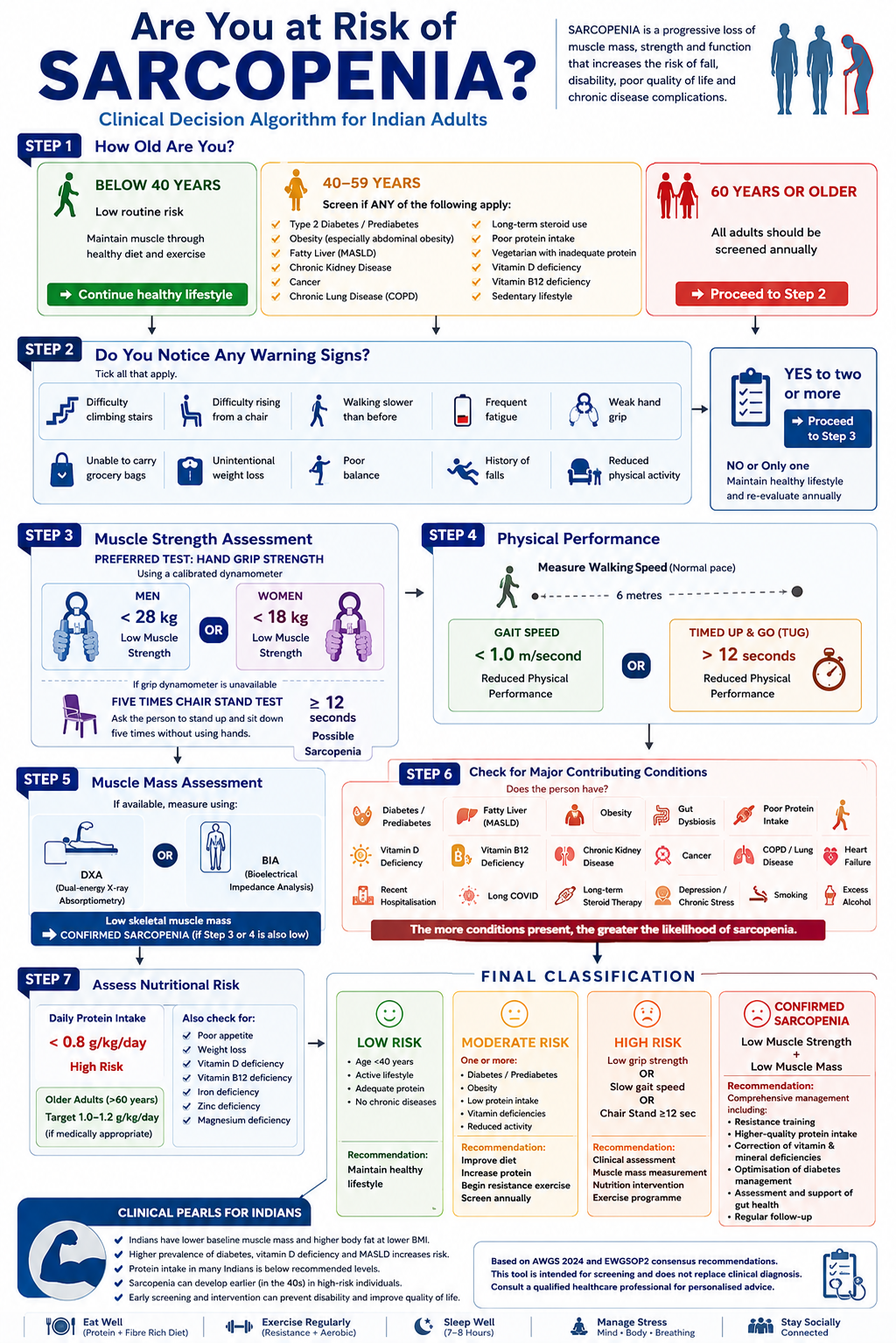



An Evidence-Based Screening Tool for Indian Adults – However, we still suggest and request meeting your HealthCare Professional for any Tests and Detailed Examination. This at best may only be considered as suggestive and not at all definitive diagnosis.
With our experince, we can emphatically say that you are the best judge of your current state of physical, emotional and mental health. Hence the following simple, suggested test to asses your muscle health at home.
The following, suggestive details are based on Scientific Guidelines and are Based almost exclusively on AWGS 2024 and EWGSOP2 consensus recommendations, hyperlinked for your quick reference. This tool is intended only for a quick screening at your end and by no means replaces clinical diagnosis.
STEP 1
How Old Are You?
🔵 Below 40 years
Low routine risk – Maintain muscle through healthy diet and exercise
➡ Continue healthy lifestyle
🟠 40–59 years
Screen if ANY of the following apply:
✓ Type 2 Diabetes
✓ Prediabetes
✓ Obesity (especially abdominal obesity)
✓ Fatty Liver (MASLD)
✓ Chronic Kidney Disease
✓ Cancer
✓ Chronic Lung Disease (COPD)
✓ Long-term steroid use
✓ Poor protein intake
✓ Vegetarian with inadequate protein
✓ Vitamin D deficiency
✓ Vitamin B12 deficiency
✓ Sedentary lifestyle
🔴 60 years or older
All adults should be screened annually
↓
Proceed to Step 2
STEP 2
Do You Notice Any Warning Signs? Tick all that apply.
□ Difficulty climbing stairs
□ Difficulty rising from a chair
□ Walking slower than before
□ Frequent fatigue
□ Weak hand grip
□ Unable to carry grocery bags
□ Unintentional weight loss
□ Poor balance
□ History of falls
□ Reduced physical activity
If YES to two or more
↓
Proceed to Step 3
STEP 3
Muscle Strength Assessment – Preferred Test is Hand Grip Strength, Using a calibrated dynamometer:
Asian Working Group Cut-offs
Men <28 kg is ↓ Low Muscle Strength
Women <18 kg ↓ Low Muscle Strength
If grip dynamometer is unavailable, Use
-
Five Times Chair Stand Test
Ask patient to stand up and sit down five times without using hands.
≥12 seconds mean ↓ Possible Sarcopenia
STEP 4
Physical Performance – Measure Walking Speed
Walk 6 metres at Normal pace
If Gait Speed is Less than –
1.0 metre/second – this indicates ↓ Reduced Physical Performance
OR
Timed Up and Go (TUG)
More than – 12 seconds means ↓ Reduced Physical Performance
STEP 5
Muscle Mass Assessment – If available, measure using:
✓ DXA
OR
✓ Bioelectrical Impedance Analysis (BIA)
Low skeletal muscle mass – means ↓ Confirmed Sarcopenia
STEP 6
Check for Major Contributing Conditions – Does the person have:
✔ Diabetes
✔ Prediabetes
✔ Fatty Liver (MASLD)
✔ Obesity
✔ Gut Dysbiosis
✔ Poor Protein Intake
✔ Low Physical Activity
✔ Vitamin D Deficiency
✔ Vitamin B12 Deficiency
✔ Chronic Kidney Disease
✔ Cancer
✔ COPD
✔ Heart Failure
✔ Recent Hospitalisation
✔ Long COVID
✔ Long-term Steroid Therapy
The more the conditions present ➡ the greater the likelihood of sarcopenia.
STEP 7
Assess Nutritional Risk – Daily Protein Intake
Less than – 0.8 g/kg/day only means High Risk of Sarcopenia
Older Adults (>60 years): Target – 1.0–1.2 g/kg/day (if medically appropriate)
Check for
□ Poor appetite
□ Weight loss
□ Vitamin D deficiency
□ Vitamin B12 deficiency
□ Iron deficiency
□ Zinc deficiency
□ Magnesium deficiency
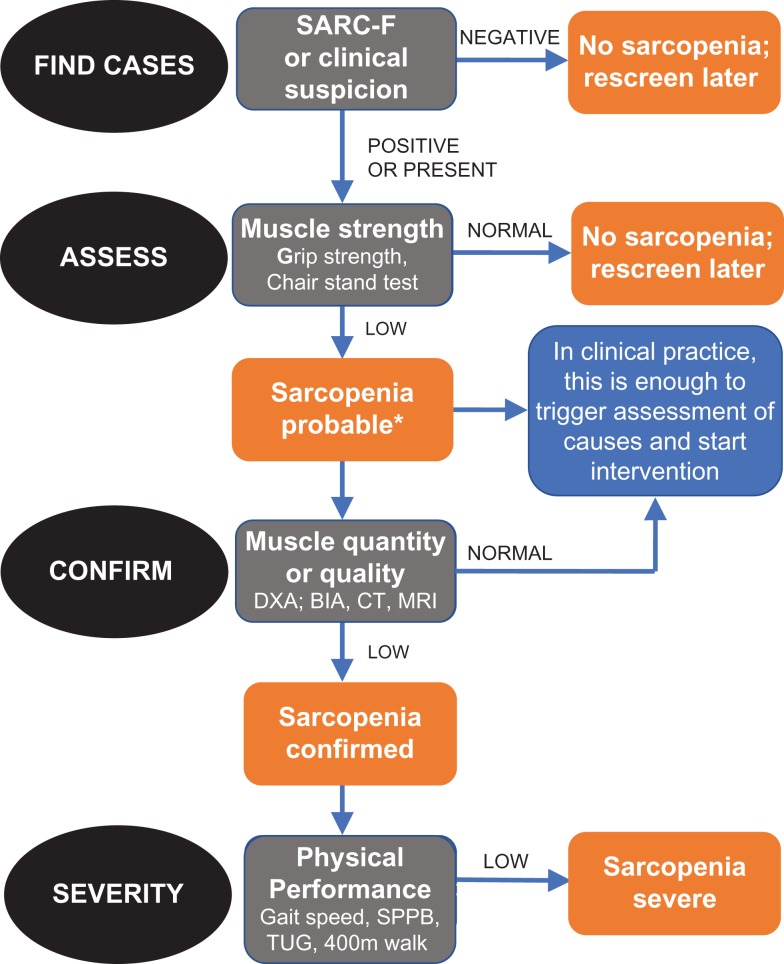
Or
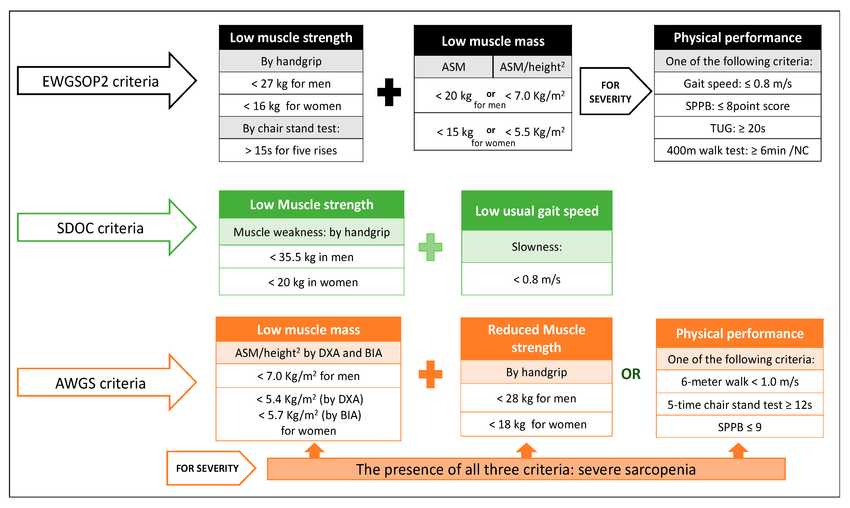
FINAL CLASSIFICATION
🟢 LOW RISK
Age <40 years
Active lifestyle
Adequate protein
No chronic diseases
Recommendation – Maintain healthy lifestyle and focus on increased Protein and Lower Carb consumption. Bulk of calories from Protein, High quality fats and Carbohydrates in that sequence.
🟡 MODERATE RISK
One or more
Diabetes
Obesity
Low protein intake
Vitamin deficiencies
Reduced activity
Recommendations – Improve you diet immediately, Increase anima proteins urgently, Begin resistance exercise and Screen semi-annually
🟠 HIGH RISK
Low grip strength OR Slow gait speed OR Chair Stand ≥12 sec
Recommendations – Clinical assessment: Muscle mass measurement followed by Nutrition intervention and Intensive Exercise programme to be instituted
🔴 CONFIRMED SARCOPENIA
Low Muscle Strength and Low Muscle Mass
Recommendations – Comprehensive management including:
-
Resistance training
-
Higher-quality protein intake, almost exclusively animal proteins
-
Correction of vitamin and mineral deficiencies
-
Optimisation of diabetes management
-
Assessment and support of gut health
-
Regular follow-ups with your HealthCare Professional