



If you walk into any tech park in Bengaluru, a corporate tower in Gurugram, or a finance hub in Mumbai, you will see thousands of young Indian men doing the exact same thing: sitting down.
They sit for two hours in heavy traffic commuting to work. They sit for eight to ten hours at a desk. They sit in cabs going home. And then, after a grueling day, they sink into the sofa for a few hours of binge-watching, doom-scrolling, or gaming.
Most men worry about what all this sitting does to their waistline, their posture, or their lower back. Almost no one thinks about what it is doing to their fertility.
A 2025 systematic review in the journal Andrology (PubMed ID: 39648572) has delivered a wake-up call to office workers everywhere: men with the highest daily sitting time—both at work and during leisure—showed lower sperm concentration, lower total sperm count, and significantly worse sperm motility compared to men who moved around more.
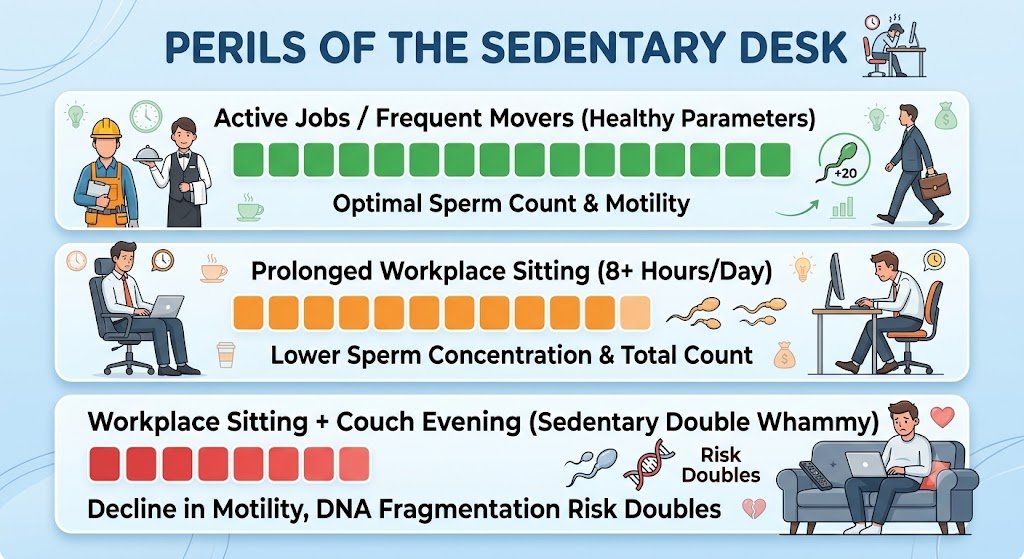
The review makes one thing crystal clear: both desk time and couch time matter. Office workers who sit for eight or more hours a day suffer worse semen parameters than men with physically active jobs. When those same office workers spend their evenings motionless on a sofa, the decline stacks up further.
For Indian men—who already face a steep, documented decline in reproductive health—the office chair is quietly acting as a biological heat trap.
Biology of the Hang: Why 2 to 4 Degrees Matter
To understand why a desk chair affects sperm, you have to look at simple human anatomy. There is a precise biological reason why the testes hang outside the human body in the scrotum, rather than sitting inside the abdomen alongside other organs:
Goldilocks Temperature: Human sperm production (spermatogenesis) requires a temperature strictly 2.0°C to 4.0°C below core body temperature (37°C).
The scrotum is an incredible natural climate-control system. When it gets cold, muscles contract to pull the testes closer to body warmth. When it gets warm, the scrotum relaxes to let heat radiate away.
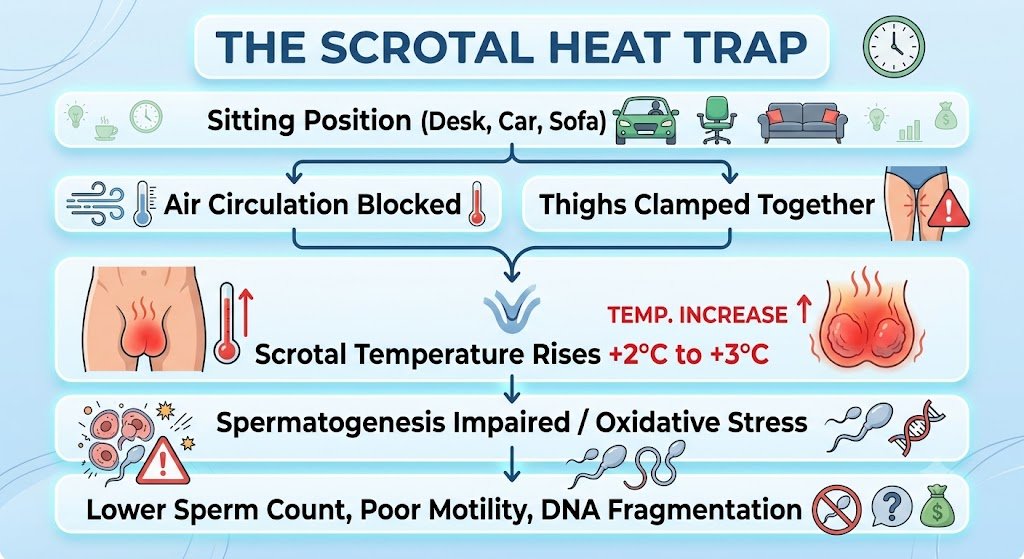
When a man sits down—especially in tight jeans, trousers, or on a padded leather chair—three things happen instantly:
-
Compression: The testes are pressed directly against the warm torso, eliminating their natural distance from core body heat
-
Trapped Air: The angle between the thighs closes, trapping ambient heat and preventing sweat evaporation
-
Vascular Stagnation: Blood flow in the pelvic floor slows down, preventing the natural cooling mechanism of the testicular veins (the pampiniform plexus)
A desk chair, a car seat, and a deep sofa all force the scrotum into this thermal trap. The cells responsible for creating sperm (Sertoli and germ cells) are exceptionally sensitive. Even a small, sustained temperature rise forces them to slow down production, create misshapen sperm, or trigger cell death (apoptosis).
Laptop Trap: Adding Fuel to the Fire
If sitting on a chair is a slow thermal burn, resting a modern laptop directly on your lap is an open flame.
A classic study published in Fertility and Sterility examined what happens when a man sits with a working laptop resting on his thighs. The researchers found that within just 30 minutes, the combination of the laptop’s internal battery heat and the closed-thigh posture required to balance it raised scrotal temperatures by about 2.7°C.
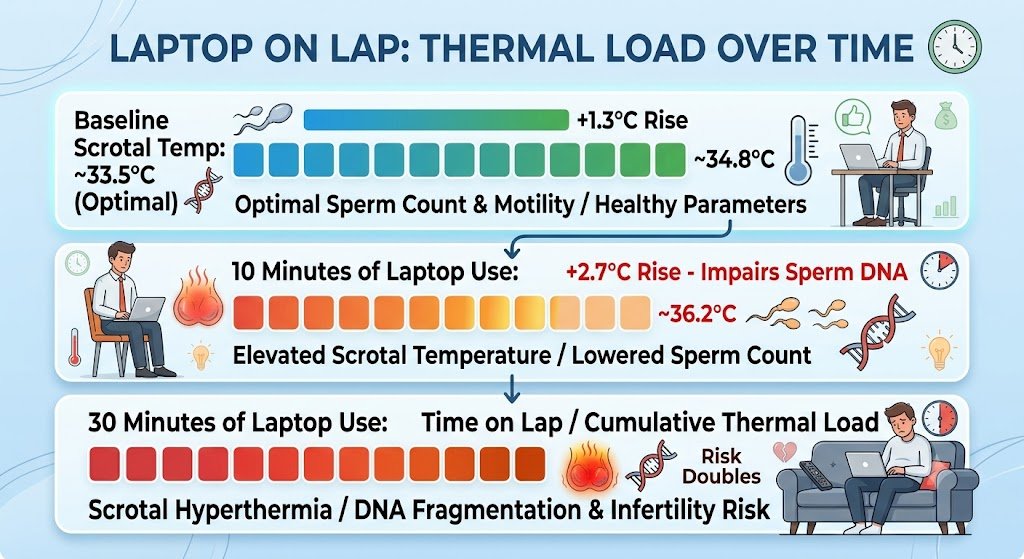
That 2.7°C rise is more than enough to disrupt the delicate enzymatic pathways inside the testes. It triggers sperm DNA fragmentation—a state where the genetic material inside the sperm head splits apart.
A man might still have a normal-looking semen volume under a basic microscope, but if his sperm DNA is fragmented by heat, achieving a healthy pregnancy becomes significantly harder, and miscarriage risks increase.
Indian Context: A Male Fertility Crisis in the Making
This global research hits home with particular force in India. Over the last two decades, South Asian fertility metrics have shown a worrying downward trend.
Double Whammy: Metabolic Fat and Scrotal Heat
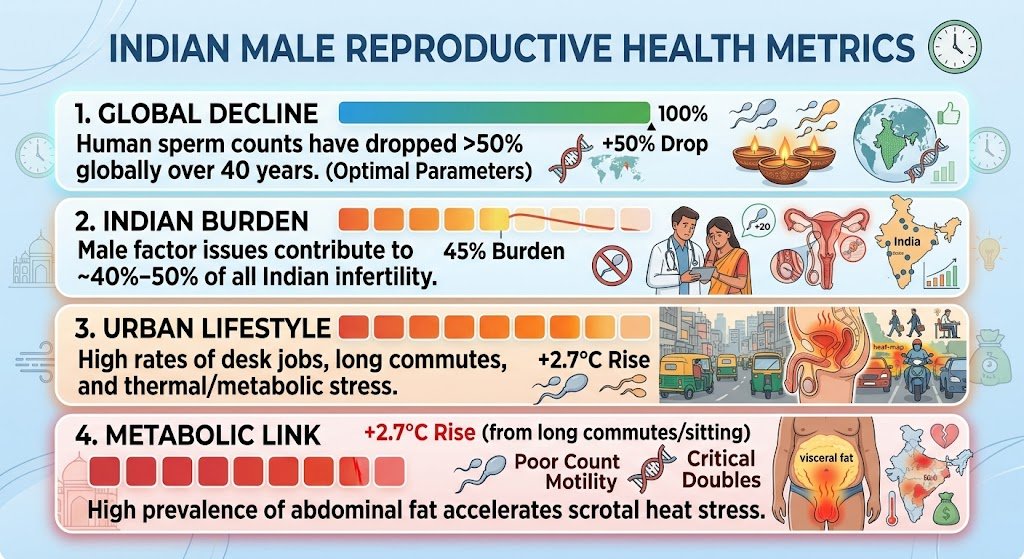
Data from clinical fertility centers across major Indian metros (such as Delhi, Bengaluru, Hyderabad, and Mumbai) reveals that male factor infertility now accounts for nearly half of all couple infertility cases.
Indian men frequently present with a metabolic profile characterized by central obesity (carrying extra fat around the lower abdomen and inner thighs). This excess body fat acts like an extra layer of thermal insulation around the pelvic basin.
When you combine internal insulation (thigh fat and visceral weight) with external heat stress (sitting for 10 hours at a desk), the scrotal microclimate rarely gets the chance to cool down to its required 33°C to 34°C zone.
Reversible Science: Chair Is Not a Lifetime Sentence
The most important and encouraging takeaway from the 2025 Andrology systematic review is that this damage is not permanent.
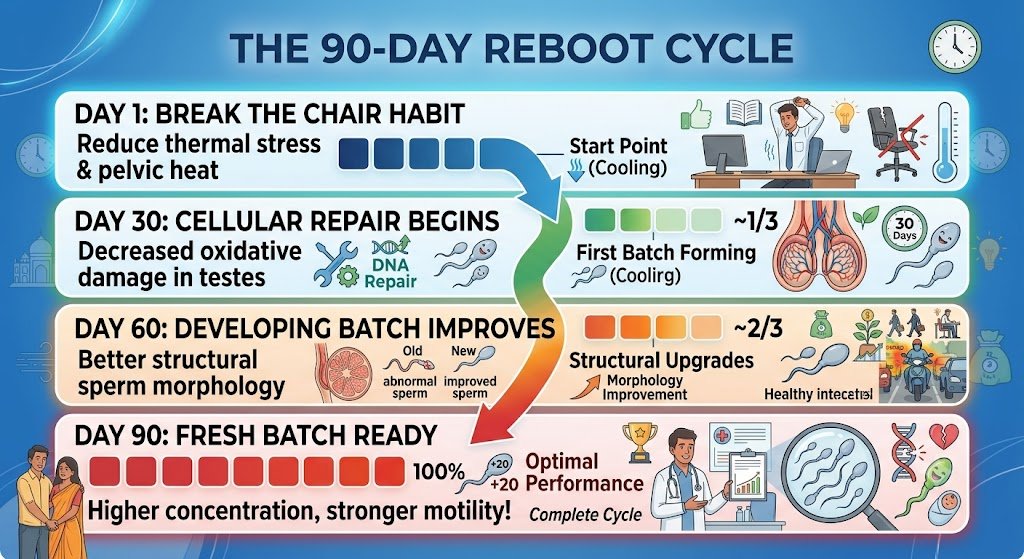
Sperm cells are constantly being produced in cycles that take roughly 72 to 90 days. This means the choices you make today will directly shape a completely fresh batch of sperm three months from now.
The review highlighted that men who systematically reduced their sitting time and increased their physical activity saw measurable improvements in sperm concentration, motility, and overall DNA integrity over time.
Practical Rules for the Indian Desk Worker
To protect your reproductive health without quitting your job, you simply need to change the thermal and physical environment around your pelvis.
Rule 1: Adopt the 45/5 Micro-Break Pattern
Set a timer on your phone or computer. After every 45 minutes of sitting, stand up for 5 minutes. Walk to get a glass of water, stretch, or simply stand during a phone call. This short break alters the pelvic angle, lets air circulate, and instantly drops scrotal temperature back to its normal baseline.
Rule 2: Get the Laptop Off Your Legs
Never use a laptop directly on your lap—even if you are using a thin pillow or cushion, which can actually trap heat further. Keep the laptop on a proper desk, or use a raised laptop stand with built-in cooling fans.
Rule 3: Rethink Your Work Wardrobe
Ditch synthetic, tight-fitting underwear, tight skinny jeans, or heavy denim if you sit for long hours. Switch to 100% breathable cotton boxers or looser briefs that allow natural air movement around the scrotum.
Rule 4: Stay Active Outside Work
If your job forces you to sit during the day, do not spend your evenings sitting on the couch. Incorporate moderate-intensity exercise—like brisk walking, jogging, cycling, or resistance training—into your daily routine. Exercise improves pelvic blood circulation, lowers systemic oxidative stress, and boosts natural testosterone production.
Conclusion: Take a Stand for Your Health
It is easy to ignore sperm health because, unlike a sore back or a headache, scrotal heat stress does not hurt. The damage happens silently, hour after hour, hidden under a desk.
The science is clear: your chair is a heat trap, but it does not have to ruin your fertility.
By making simple adjustments—standing up every 45 minutes, keeping laptops off your lap, wearing breathable clothing, and moving more throughout the day—you can break the thermal cycle and protect your reproductive health for the long run.
Scientific References
-
2025 Meta-Analysis on Sitting and Sperm Quality:
Sedentary behavior and male reproductive parameters: A systematic review and meta-analysis. Andrology (2025). PubMed ID: 39648572
-
Laptop Heat and Scrotal Hyperthermia:
Sheynkin, Y., Welliver, C., Zhang, Z., & Hajiyousif, F. (2011). Protection from scrotal hyperthermia in laptop computer users. Fertility and Sterility, 95(2), 521–523. PubMed ID: 21051052
-
Scrotal Temperature and Spermatogenesis:
Durairajanayagam, D., Agarwal, A., & Ong, C. (2015). Causes, effects and molecular mechanisms of testicular heat stress. Reproductive Biomedicine Online, 30(1), 14–27