



If you took a time machine back to 1986, found your grandfather when he was 40 years old, and drew his blood, you would find something surprising: his total testosterone levels would easily beat yours today—even if you lift weights, track your macros, and eat clean.
This isn’t just about aging or modern habits. It is a biological trend that has been quietly unfolding across the globe for four decades and more.
A landmark 2007 study published in The Journal of Clinical Endocrinology & Metabolism (PubMed ID: 17062768) delivered a striking revelation: male testosterone levels have been dropping by roughly 1% per year across the entire population.
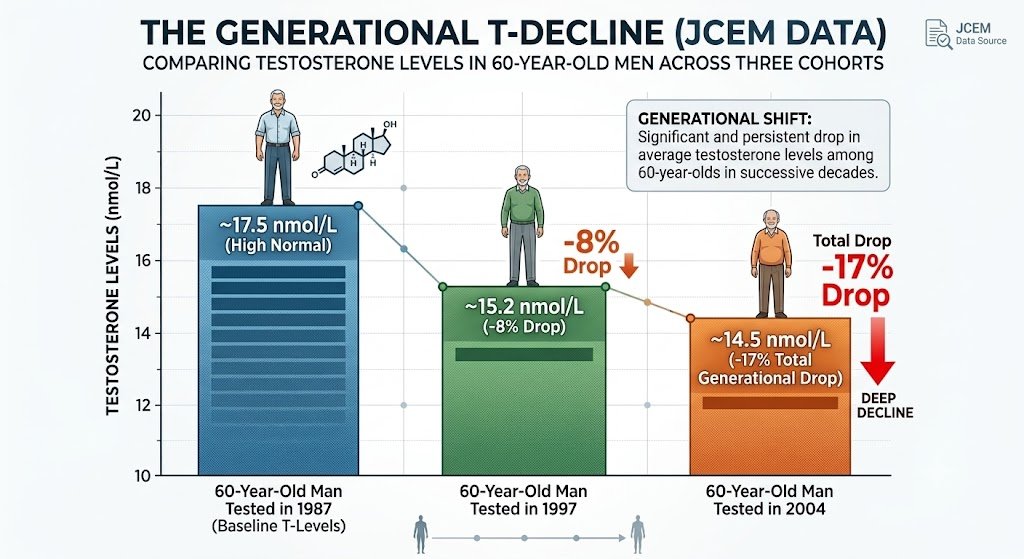
Led by Dr. Thomas Travison at the New England Research Institutes, the study tracked 1,709 men across three distinct time periods: 1987–1989, 1995–1997, and 2002–2004.
The researchers discovered that a 60-year-old man tested in 2004 had 17% less testosterone than a 60-year-old man tested in 1987. The decline held strong even after adjusting for body mass index (BMI), smoking habits, alcohol consumption, medications, and chronic illnesses.
Something beyond personal health choices is lowering testosterone across entire populations. The downward trend has been running for at least forty years, and the men standing on it didn’t choose to be there.
Mystery Driver: If It Isn’t Obesity, What Is It?
When doctors see falling testosterone in an individual patient, the usual suspects are straightforward: gaining weight, sleeping poorly, lack of exercise, or high stress.
However, when testosterone drops across an entire generation of men at every age bracket, those individual explanations fall short.
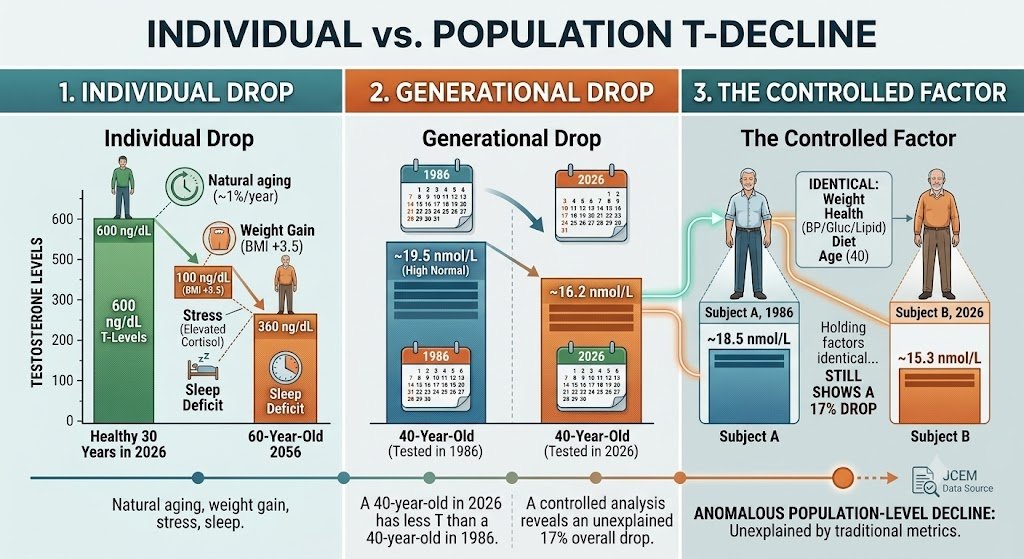
When Dr. Travison’s team statistically removed the effects of rising obesity, smoking rates, and illness, the generational decline remained. The study concluded that an unknown, broad environmental or population-wide factor was actively suppressing male endocrine function.
Main Suspects: Endocrine-Disrupting Chemicals (EDCs)
The leading scientific explanation points toward our modern chemical environment. Over the last 50 years, thousands of synthetic chemical compounds have entered our daily lives: in food packaging, plastics, personal care items, water supplies, and agricultural pesticides.
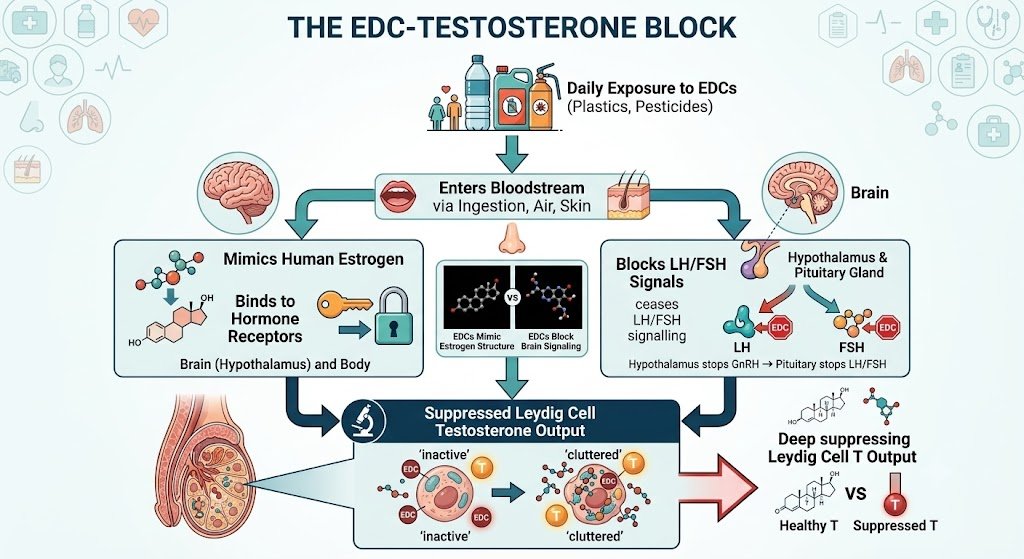
Many of these compounds are Endocrine-Disrupting Chemicals (EDCs). They mimic, block, or interfere with human hormones at extremely small doses.
The Big Three Chemical Families
-
Phthalates (Plasticizers): Used to make plastics flexible and to lock in fragrance in shampoos, soaps, and deodorants. Phthalates disrupt the Leydig cells inside the testes—the primary factories where testosterone is produced
-
Bisphenols (BPA, BPS, BPF): Found in plastic bottles, food container linings, and thermal paper receipts. Bisphenol A acts as a synthetic estrogen (xenoestrogen), binding to hormone receptors and tricking the brain into thinking the body already has excess sex hormones, which dials down natural T production
-
PFAS (“Forever Chemicals”): Water- and grease-resistant compounds used in non-stick cookware, stain-resistant fabrics, and food wrappers. PFAS build up in human tissue over decades and are linked to lower testosterone and reduced sperm quality
Exposure to these synthetic compounds has risen in lockstep with the generational drop in testosterone.
Indian Context: A Double Burden for Indian Males
This global trend carries distinct consequences in India, where rapid urbanization, industrial growth, and lifestyle shifts intersect with South Asian biology.
1. The Visceral Fat and Aromatase Connection
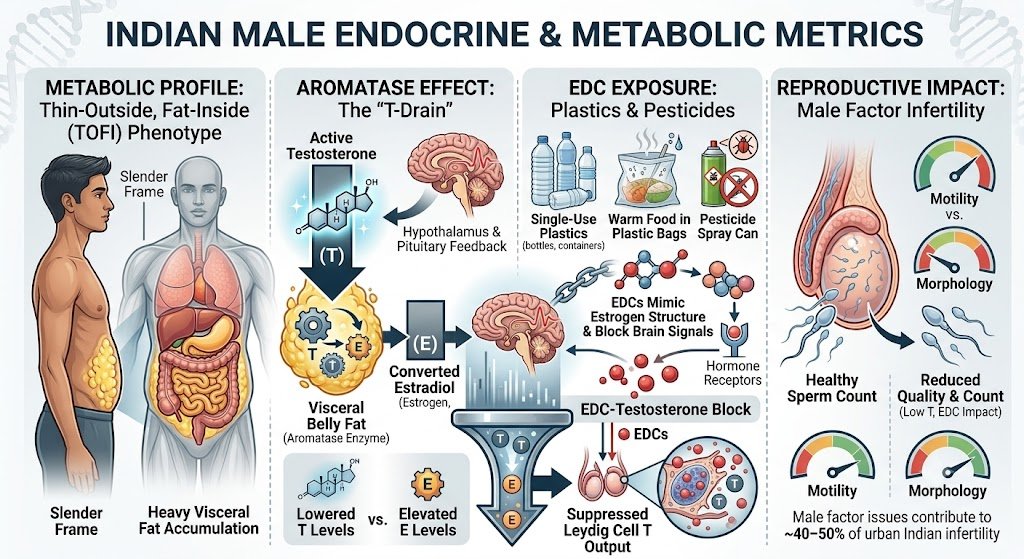
South Asian men frequently exhibit the Thin-Outside, Fat-Inside (TOFI) body composition—carrying higher levels of hidden visceral fat around abdominal organs, even with a normal BMI.
Visceral fat is rich in an enzyme called aromatase. Aromatase converts active testosterone into estradiol (a form of estrogen).
When you combine high baseline EDC exposures (which act like estrogen) with high visceral fat levels (which convert T into estrogen), Indian men face a dual challenge to maintaining optimal testosterone levels.

2. High Microplastic and EDC Accumulation
From drinking hot tea out of thin plastic cups to packing warm, oily rotis in plastic containers, daily contact with warm plastics accelerates EDC leaching directly into food and drinks.
In addition, high pesticide usage in agricultural runoff means everyday food staples often carry residual endocrine disruptors into the food chain.
How Lower T Shows Up in Daily Life
Testosterone is far more than a muscle-building hormone. It is a foundational signaling molecule that regulates mood, energy, vascular function, metabolic rate, and bone density.

When population-wide testosterone drops by 15–20%, symptoms show up long before medical thresholds for hypogonadism are reached:
-
Persistent Mental Fatigue: Reduced drive, difficulty focusing, and a general lack of enthusiasm.
-
Metabolic Slowdown: Difficulty burning visceral fat, even with calorie-controlled diets.
-
Reduced Physical Recovery: Prolonged muscle soreness and difficulty building strength.
-
Vascular & Sexual Changes: Decreased morning erections and subtle shifts in microvascular function.
Taking Action: An Anti-EDC and T-Optimization Strategy
You cannot control global industrial manufacturing, but you can significantly reduce your exposure to hormone-disrupting chemicals while naturally supporting your body’s hormone production.
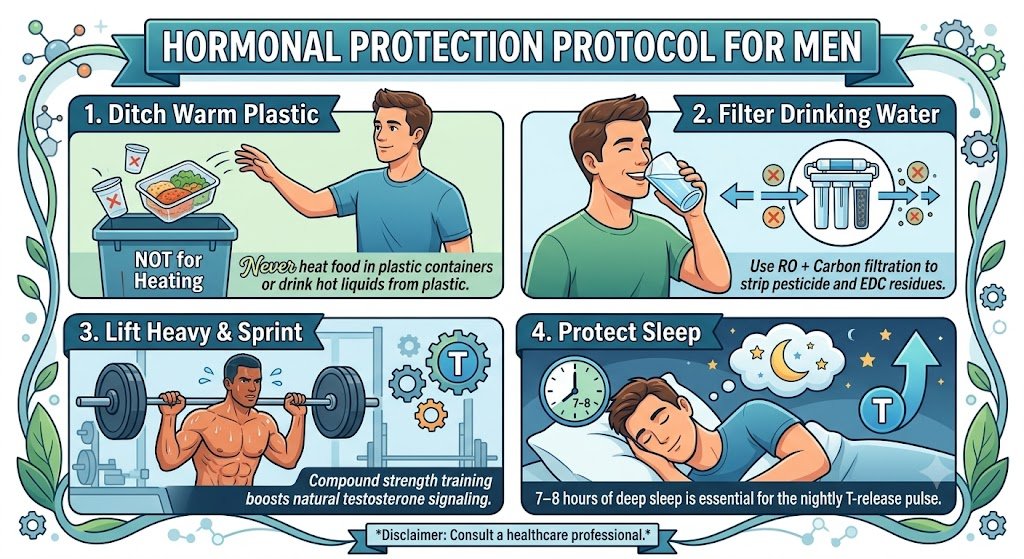
Step 1: Remove Plastics from Hot Food and Drinks
Heat accelerates the migration of phthalates and bisphenols out of plastics and into food.
-
Store and heat meals exclusively in glass, stainless steel, or ceramic containers.
-
Never pour hot chai, coffee, or soup into disposable plastic bags or thin styrofoam cups.
-
Swap out plastic water bottles for food-grade stainless steel or glass bottles.
Step 2: Filter Your Water and Choose Clean Personal Care
Invest in a quality water purifier with Activated Carbon and Reverse Osmosis (RO) to strip trace industrial chemicals and pesticides from municipal drinking water.
Switch to phthalate-free, fragrance-free soaps, shampoos, and deodorants to avoid absorbing synthetic compounds through the skin every morning.
Step 3: Train Compound Movements
Progressive strength training (squats, deadlifts, overhead presses) stimulates androgen receptor sensitivity in skeletal muscle and encourages natural hormone production. Aim for 3 to 4 days of heavy compound lifting per week.
Step 4: Protect Sleep Quality
The majority of a man’s daily testosterone is produced during deep, slow-wave sleep cycles. Sleeping less than 6 hours per night can drop daytime testosterone levels by 10% to 15% after just one week—effectively aging a man’s hormonal profile by a full decade.
Conclusion: Understanding the Shift
The generational drop in testosterone identified by Dr. Thomas Travison’s team shows that modern environmental shifts are having a real impact on human biology.
Your grandfather’s higher testosterone levels weren’t an accident—they were the result of living in a world with fewer synthetic chemicals, cleaner water, more ovements under the sun and less processed foods.
While you cannot change the era you are born into, understanding this hidden trend gives you the tools to take action. By cutting down on EDC exposures, prioritizing deep sleep, lifting heavy and staying active, you can protect your health and optimize your hormone levels for the future.
Scientific References
-
The Landmark Generational T-Decline Study:
Travison, T. G., Araujo, A. B., O’Donnell, A. B., Kupelian, V., & McKinlay, J. B. (2007). A population-level decline in serum testosterone levels in American men. The Journal of Clinical Endocrinology & Metabolism, 92(1), 196–202. PubMed ID: 17062768
-
Endocrine Disruptors and Male Reproductive Health:
Gore, A. C., Chappell, V. A., Fenton, S. E., Flaws, J. A., Nadal, A., Prins, G. S., Toppari, J., & Zoeller, R. T. (2015). EDC-2: The Endocrine Society’s Second Scientific Statement on Endocrine-Disrupting Chemicals. Endocrine Reviews, 36(6), E1–E150
-
Phthalate and BPA Exposure and Testosterone Suppression:
Meeker, J. D., & Ferguson, K. K. (2014). Relationship between urinary phthalate and bisphenol A concentrations and serum total testosterone levels in US population. The Journal of Clinical Endocrinology & Metabolism, 99(11), 4346–4352