



Hair on Head play a major role in how men see themselves and how they are perceived by others. Thick, healthy hair is culturally associated with youth, strength and masculinity. When hair loss occurs, it affects not only confidence BUT also raises Cardiac Risk – No there is no typo and yes, you read it correct. Male pattern alopecia is directly and intrinsically related to Cardiovascular Risk – the theme of this this article. Do share extensively with your loved ones…
Walk through any morning clinic in Chennai, Delhi, Mumbai or Bengaluru, and you will observe two distinct clinical trends intersecting in real-time. First, young Indian males are presenting with male pattern hair loss—specifically vertex androgenetic alopecia—at increasingly early ages. Second, these same young men are suffering from premature, aggressive coronary artery disease (CAD), often presenting with acute myocardial infarction a decade earlier than their Western counterparts.
No one thought – both these clinical conditions could be more co-related than one could imagine, not even your Doctor. Not as yet. For years, these two phenomena were treated as entirely separate medical domains: one belonging to dermatology, the other to cardiology.
However, a landmark meta-analysis published in BMJ Open by Dr. Tomohide Yamada and his team at the University of Tokyo (PubMed ID: 23554099) revealed a profound physiological link: men with severe baldness on the top of the head (the vertex or crown) have a 32% higher risk of developing coronary heart disease.
Crucially, the study demonstrated that pattern matters. While a receding frontal hairline showed no significant association with heart disease, vertex baldness was associated with a 52% higher risk of coronary heart disease in men under 55 years of age, and a 36% higher risk overall.
For Indian men—who possess a well-documented genetic, metabolic and vascular susceptibility to early-onset cardiovascular disease—crown / vertex hair loss is far more than an aesthetic concern. It serves as a visible cutaneous biomarker for underlying arterial pathology, metabolic dysfunction, and microvascular stress.
Japanese Meta-Analysis: Unpacking the Epidemiological Data
The University of Tokyo meta-analysis pooled data across six prospective cohort and case-control studies involving 39,329 male participants. By standardizing hair loss patterns using validated scales (such as the Hamilton-Norwood classification), the researchers isolated the specific cardiovascular risk profiles associated with different types of male pattern baldness.
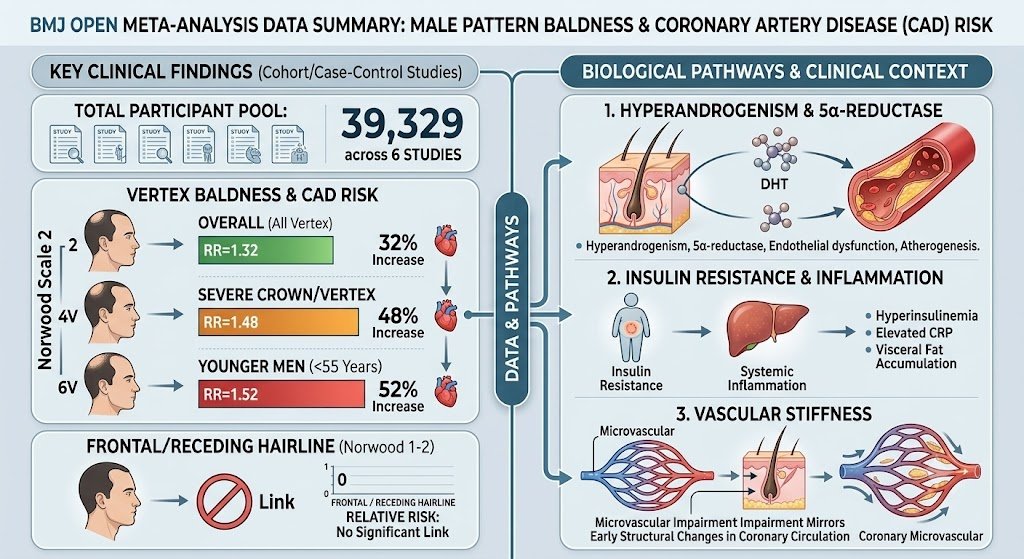
The study’s most critical finding was that the association between crown / vertex baldness and coronary artery disease remained statistically significant even after adjusting for traditional cardiovascular risk factors:
-
Age
-
Smoking status
-
Systolic and diastolic blood pressure
-
Serum lipid levels (Total Cholesterol, LDL, HDL)
-
Body Mass Index (BMI)
This adjustment proves that a thinning crown provides predictive clinical information above and beyond what standard blood panels and blood pressure cuffs measure.
Epidemiological Context: Indian Male Vascular Paradox
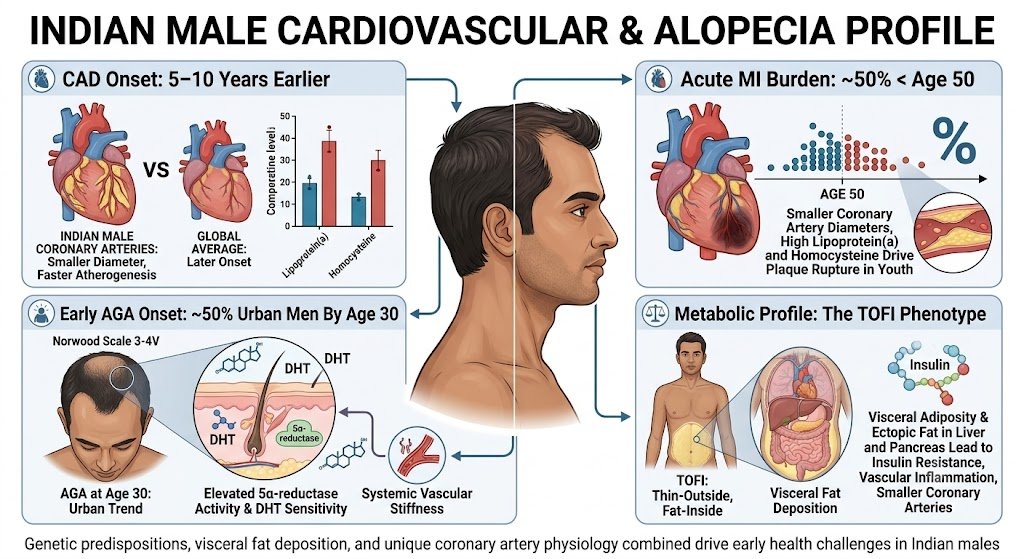
To fully appreciate the severity of these findings, they must be situated within the landscape of South Asian cardiovascular epidemiology. Indian men suffer from premature coronary artery disease that is characterized by early onset, diffuse multivessel involvement, and high mortality rates.
Indian Male CAD Burden
-
Early Onset: According to registry data from the Indian Council of Medical Research (ICMR) and the CREATE Registry, nearly 50% of acute myocardial infarctions in Indian men occur below 50 years of age, and 25% occur below 40 years of age
-
The TOFI Phenotype: South Asian men frequently exhibit the Thin-Outside, Fat-Inside (TOFI) body composition—carrying high visceral adiposity, high baseline systemic inflammation, and marked insulin resistance despite having a normal BMI
Indian Male Alopecia Burden
Recent epidemiological surveys across urban Indian cohorts show that Androgenetic Alopecia (AGA) affects up to 50% of men by age 30–35, with an increasing proportion presenting with early-stage vertex thinning.
When an Indian man under 45 exhibits severe crown thinning, he is simultaneously displaying two phenotypes linked to the same underlying metabolic and vascular drivers.
Biological Axis: Connecting Scalp Follicles to Coronary Arteries
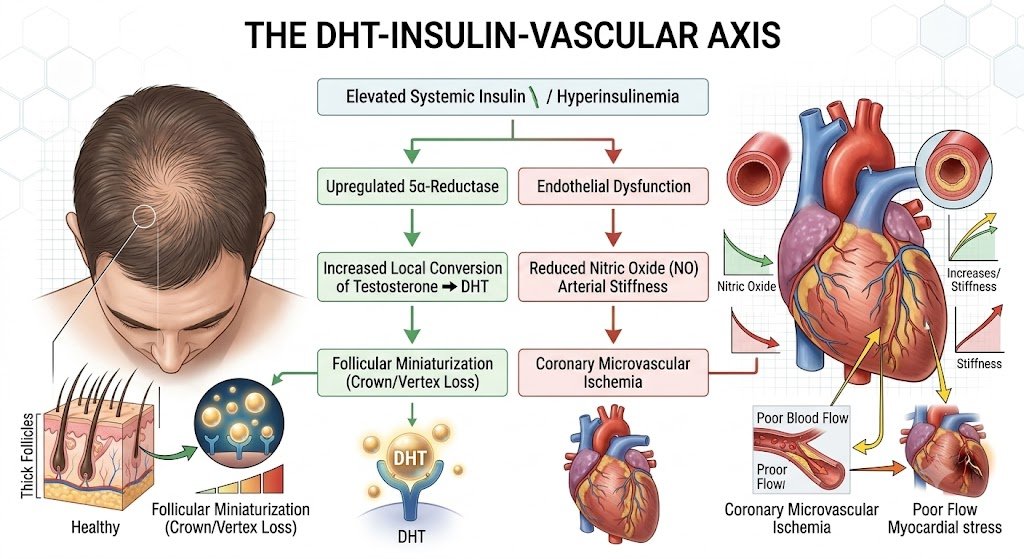
Why does hair loss on the top of the head track arterial disease in the heart? The connection rests on a shared cellular and biological axis: dihydrotestosterone (DHT) sensitivity, microvascular rarefaction, and hyperinsulinemia.
1. Dihydrotestosterone (DHT) and Androgen Receptor Density
Male pattern baldness is driven by the conversion of testosterone into dihydrotestosterone (DHT) by the enzyme 5-alpha reductase. Scalp hair follicles in the vertex region possess a significantly higher density of androgen receptors and 5-alpha reductase activity compared to frontal follicles.
Crucially, androgen receptors are not restricted to hair follicles; they are expressed throughout the human cardiovascular system, including vascular smooth muscle cells and endothelial linings. Elevated tissue sensitivity to DHT promotes:
-
Vascular smooth muscle cell proliferation
-
Arterial wall thickening and reduced vascular compliance
-
Accelerated atherosclerotic plaque maturation
2. Microvascular Rarefaction and Follicular Ischemia
Hair follicles on the scalp are among the most metabolically active structures in the body, requiring robust capillary networks for growth. In men with vertex baldness, cutaneous biopsy studies reveal microvascular rarefaction—a severe reduction in microvascular capillary density around the dermal papilla.
This exact same microvascular degradation occurs in the myocardium. Coronary microvascular dysfunction—where small resistance arteries fail to dilate properly—often precedes macrovascular epicardial coronary artery blockage by several years. The thinning scalp crown reflects microvascular starvation happening simultaneously in cardiac tissue.
3. Hyperinsulinemia and Insulin Resistance
Multiple metabolic studies demonstrate that young men with early-onset vertex baldness have significantly higher fasting insulin levels, elevated HOMA-IR scores, and higher rates of Impaired Fasting Glucose (IFG).
Hyperinsulinemia creates a destructive cascade:
-
Increases Free Androgen Levels: High insulin suppresses Sex Hormone-Binding Globulin (SHBG), increasing free circulating testosterone and DHT
-
Damages Endothelium: Chronic high insulin impairs nitric oxide (NO) synthesis in blood vessels, leading to systemic vasoconstriction, arterial stiffness, and hypertension
Diagnostic & Clinical Biomarkers: What to Screen
Because vertex hair loss is visible years before an acute cardiac event occurs, clinicians and patients can use it as a trigger for early cardiovascular screening.

Essential Laboratory Panel for Men with Early Vertex Baldness
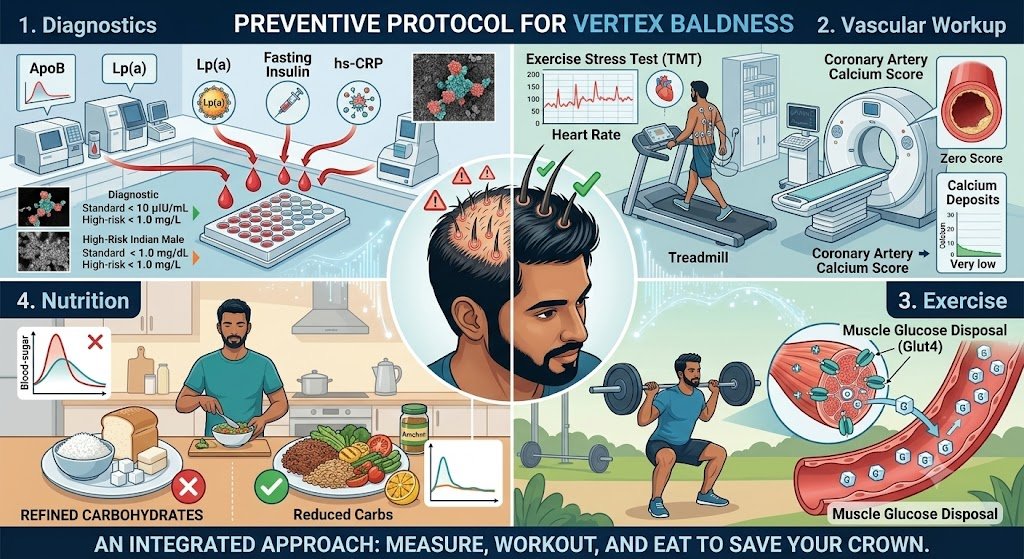
If a man under 50 presents with significant crown thinning, a standard lipid panel alone is insufficient. The following advanced markers should be evaluated:
-
ApoB (Apolipoprotein B): Measures the exact particle number of atherogenic lipoproteins (LDL, VLDL, IDL). In South Asians, ApoB is a vastly superior predictor of myocardial infarction compared to standard LDL-C
-
Lipoprotein(a) [Lp(a)]: A genetically determined, highly atherogenic lipid particle. Over 25% of South Asians possess elevated Lp(a) (>50 mg/dL), which drives premature clot formation and arterial narrowing
-
hs-CRP (High-Sensitivity C-Reactive Protein): A key marker of systemic vascular inflammation. Chronic low-grade microvascular inflammation drives both follicular miniaturization and vascular endothelial decay
-
Fasting Insulin & HOMA-IR: Uncovers hidden metabolic dysfunction long before HbA1c or fasting glucose levels cross diabetic thresholds
Practical Clinical Protocol for Indian Men
Recognizing vertex hair loss as a potential marker for metabolic and cardiovascular risk allows for early, targeted intervention.
Action Plan for Patients and Clinicians
-
Look Beyond the Scalp: When evaluating hair loss treatments (like topical minoxidil or oral 5-alpha reductase inhibitors), use the consultation as an opportunity to assess metabolic health, blood pressure, and lifestyle factors
-
Target Insulin Sensitivity: Transition from high-glycemic, refined carbohydrate diets to whole-food diets rich in fiber, healthy fats, and adequate protein to drop fasting insulin levels and improve arterial endothelial function
-
Incorporate Resistance Training: Progressive overload weight training increases skeletal muscle mass—the body’s primary sink for glucose disposal—effectively reversing insulin resistance and lowering systemic inflammation
-
Screen Early for Coronary Calcium: For men over 35 with early vertex baldness and a family history of premature heart disease, a Coronary Artery Calcium (CAC) scan can detect silent subclinical atherosclerosis before symptoms appear
Conclusion: Reading the Scalp as a Mirror of the Heart
The meta-analysis led by Dr. Tomohide Yamada provides a clear clinical insight: the human scalp reflects systemic arterial and metabolic health.
Crown / Vertex male pattern baldness is not a random cosmetic occurrence. It is an outer manifestation of an internal endocrine and vascular environment marked by androgen receptor sensitivity, microvascular insufficiency, hyperinsulinemia, and systemic inflammation.
For the young Indian male—operating under a baseline elevated genetic risk for early heart disease—a thinning hair crown is an invaluable early warning sign. The hair loss is visible; the coronary artery disease it tracks, is silent.
Paying attention to what is happening on top of the head offers a crucial opportunity to protect what is happening inside the chest. Take care of Both.