



We certainly and absolutely hate to be bearer of bad news but our only objective is for others to learn from this bad news and quickly and effectively course-correct, so as to avoid similar fate. As part of our Evidence-Explained™ series – we present you extremely concerning findings from The Lancet Regional Health – Southeast Asia, April 2026 publication Titled – DiaFib-Liver Study. Don’t miss a word of this article, if you wish to safeguard yourself and your loved ones…..
DiaFib-Liver Study: Key Findings
A landmark multicenter investigation published in The Lancet Regional Health – Southeast Asia (April 2026) has exposed a silent, rapidly growing public health crisis across India. Titled the DiaFib-Liver Study, this cohort analysis represents the largest real-world survey of liver fibrosis in Type 2 Diabetes (T2D) ever conducted in a low- or middle-income nation.
Should you be interested, you can download a Full Copy of this Publication, here –Lancet DiaFib-Liver Study March 2026
One in four Indians with Type 2 diabetes had clinically significant liver fibrosis. One in seven had advanced fibrosis. One in 20 had liver-stiffness values consistent with probable cirrhosis. And the risk did not disappear simply because a patient was not obese.

That is the central message from the DiaFib-Liver Study, a large multicentre Indian investigation published in The Lancet Regional Health – Southeast Asia. The study examined 9,202 adults with Type 2 diabetes (T2D) and provides some of the clearest real-world evidence to date that clinically important liver fibrosis is a major—and frequently overlooked—component of diabetes care in India.
Headline numbers from DiaFib Liver Study
The findings establish advanced chronic liver damage as the “fourth major vascular/organ complication” of T2D—standing alongside retinopathy, nephropathy, and neuropathy.
DiaFib-Liver finding |
Patients |
Approx. proportion |
|---|---|---|
Total T2D cohort |
9,202 |
100% |
Clinically significant fibrosis, LSM ≥8 kPa |
2,433 |
26% |
Advanced fibrosis, LSM ≥10 kPa |
1,289 |
14% |
Probable cirrhosis, LSM ≥15 kPa |
491 |
5% |
Hepatic steatosis among those with CAP data |
5,289/8,136 |
65% |
Significant fibrosis despite no detectable steatosis |
370/2,847 |
13% |
Probable cirrhosis despite no detectable steatosis |
107/2,847 |
4% |
Significant fibrosis among non-obese T2D |
752/3,996 |
19% |
The fibrosis categories are based on vibration-controlled transient elastography (VCTE/FibroScan) liver-stiffness measurements rather than liver biopsy. Importantly, these are threshold-defined categories and “probable cirrhosis” should not be interpreted as biopsy-confirmed cirrhosis.
Despite the severity of tissue scarring, the vast majority of affected patients remained completely asymptomatic, with normal liver enzyme panels (ALT/AST).
Non-Obese Subgroup & “Burnt-Out” Fat Paradox
A central insight from the study refutes the clinical assumption that liver fibrosis exclusively affects overweight or obese individuals:
-
The Lean Phenotype: 19% of non-obese T2D patients (BMI < 25 kg/m²) harbored clinically significant liver fibrosis. In this subgroup, age emerged as the single independent predictor of disease progression
-
The Fat-Fibrosis Dissociation: 13% of patients without hepatic steatosis (defined by Controlled Attenuation Parameter CAP < 248 dB/m) already suffered from clinically significant fibrosis
-
Burnt-Out Steatohepatitis: 4% of non-fatty patients had LSM values consistent with probable cirrhosis (15.0 kPa). As hepatic scarring reaches advanced stages, fat cells are displaced by dense collagen matrix, leading to a false-negative appearance on standard ultrasound scans
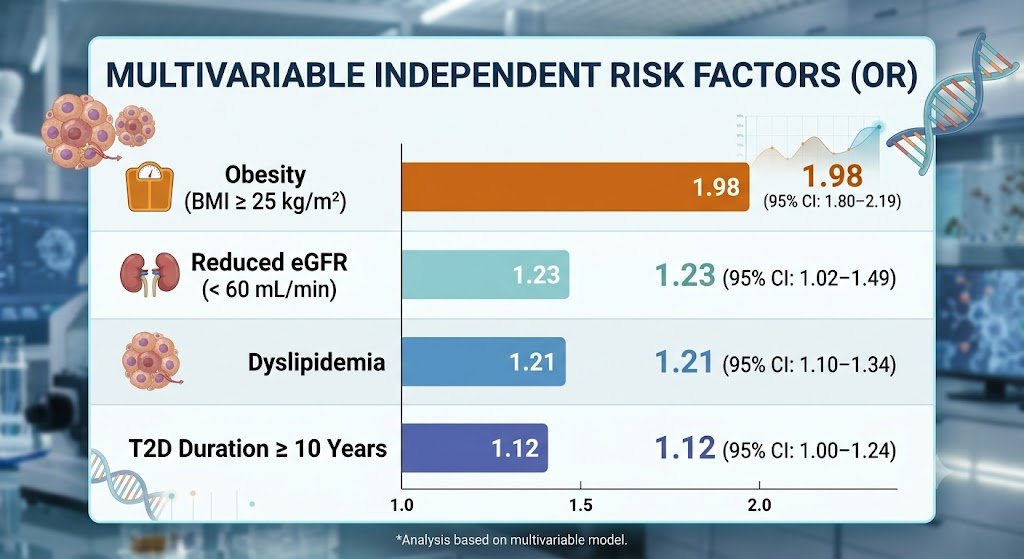
Multivariable Logistic Regression: Predictors of Scarring
Through multivariable analysis, researchers identified key independent drivers of liver fibrosis in Indian T2D cohorts:
Geographical Disparities
Prevalence varied significantly across geographic regions in India, peaking at 30% in Southern India compared to 21% in Central India, pointing toward underlying genetic, dietary, and regional metabolic variations.
Clinical Implications & Strategic Paradigm Shift

Diabetes duration matters—but the relationship is complex
Among patients with clinically significant fibrosis, 36% had diabetes for at least 10 years, compared with 31% among those without significant fibrosis. In multivariable analysis, diabetes duration ≥10 years was independently associated with clinically significant fibrosis:
Odds Ratio 1.115; 95% CI 1.001–1.243.
The effect size is modest compared with obesity, but biologically important. It supports the concept that the cumulative metabolic exposure associated with diabetes matters. This is particularly relevant in India, where T2D often develops at a relatively young age.
A patient diagnosed with diabetes at 40 may therefore accumulate 20–25 years of metabolic exposure while still being below traditional “elderly” age thresholds.
Kidney disease and dyslipidaemia add another layer of risk
The fibrosis group had higher levels of several metabolic and vascular comorbidities. Among people with clinically significant fibrosis:
-
55% had hypertension
-
55% had dyslipidaemia
-
9% had coronary artery disease
-
8% had reduced eGFR
compared with 49%, 47%, 7% and 6%, respectively, among those without significant fibrosis. This is clinically relevant because it reinforces the concept that MASLD/MASH and fibrosis are not isolated liver problems. They sit within the broader cardiometabolic disease network.
The patient with: T2D + dyslipidaemia + CKD + obesity
may therefore represent a particularly important liver-risk phenotype.
Regional variation was substantial
The national average also concealed geographic differences. The prevalence of clinically significant fibrosis ranged from approximately:
21% in central India
to
30% in southern India.
The investigators reported significant regional variation across participating centres. However, this should not be interpreted as definitive state-level prevalence.
The study was multicentre rather than a nationally representative probability survey, and differences could reflect patient mix, referral patterns, metabolic characteristics and centre-specific populations. Still, the geographic variation is an important signal for future research.
DiaFib-Liver fits into a much larger Indian liver story
The study becomes even more interesting when placed beside the Phenome India findings published earlier in 2026. Phenome India evaluated 10,267 adults recruited through 37 CSIR laboratories across 27 Indian cities; 7,764 were ultimately included.
The study found:
47.8% crude MASLD prevalence
and
38.9% age-adjusted MASLD prevalence
(95% CI 37.2–40.6%).
But significant fibrosis was much less common in that broader population:
-
6.3% of people with MASLD had LSM ≥8.2 kPa
-
age-adjusted significant fibrosis prevalence among MASLD was 4.1%
-
overall age-adjusted significant fibrosis prevalence was 2.4%.
The contrast is revealing.
Population |
Key finding |
|---|---|
Phenome India — general adult cohort |
Age-adjusted MASLD 38.9% |
Phenome India |
Overall age-adjusted significant fibrosis 2.4% |
DiaFib-Liver — T2D population |
Clinically significant fibrosis 26% |
DiaFib-Liver |
Advanced fibrosis 14% |
DiaFib-Liver |
Probable cirrhosis 5% |