



Vitamins and Mineral Supplements, unfortunately, are becoming necessary and extremely important for Indians on account of persistent, pervasive and extensive key vitamins and mineras’ deficiencies in Indians. The objective of this series is to help you decipher Scienec of Supplements from Fancy Marketing and help you choose an appropriate Supplement for its best benefits to your body and a bang for your buck. Read On..
Browse any online supplement store or if you come across Insta Influencers subtly pushing products, you’ll quickly discover that buying a Vitamin is no longer as simple as choosing “Vitamin D” or “Vitamin E.”
Importance of Choosing Right Form of Vitamins and Minerals
Instead, consumers are presented with an overwhelming array of different chemical forms of a same Vitamin, e.g.: Vitamin D2 or Vitamin D3, Vitamin K1 or MK-7, natural or synthetic Vitamin E, Retinol or Beta-carotene for Vit A.
Premium formulations often go a step ahead and claim to offer “superior absorption,” “better bioavailability,” or “clinically proven efficacy” as a differentiator while standard, older products promise similar benefits at a fraction of the price.
The obvious question is: Do these different forms of a Same Vitamin really matter – both from benefits and pricing point of View?
The scientific answer is yes—but not always in the exact same way as fancy marketing suggests.
Vitamins and Minerals do exist in multiple chemical forms that have differential properties and usages. These different chemical forms differ substantially in absorption by your body, metabolism in your body, tissue distribution inside body, biological activity, half-life of the Vitamin and mineral, and lastly in clinical efficacy.
In most of the situations, selecting the wrong form of a Vitamin or Mineral may not only have poor efficacy but also lost opportunity. In other times, it can influence treatment outcomes, particularly in people with aging-related changes, gastrointestinal disorders, liver disease, kidney disease, obesity, bariatric surgery, genetic polymorphisms, or medications that interfere with Vitamins and Minerals’ metabolism.
Understanding these differences has become increasingly important as nutritional science has evolved from preventing classic deficiency diseases to optimizing long-term health, healthy aging, immune function, skeletal integrity, neurological performance and cardiometabolic health.
This Series examines the Fat-soluble Vitamins such as — Vit. A, D, E, and K—and Water Soluble Vitamins – Vit B and Vit C – through the lens of modern evidence-based medicine.
Rather than relying simply on marketing claims, we help you evaluate the scientific literature to determine which supplemental forms have the strongest clinical support from human clinical trials, pharmacokinetic studies, systematic reviews, meta-analyses, and international clinical guidelines.
Why One Vitamin Can Exist in Multiple Forms
A vitamin is not always a single molecule. Many vitamins comprise a family of structurally related compounds that share similar biological functions but differ in their chemical properties. Small differences in molecular structure can substantially influence:
-
Intestinal absorption
-
Stability during storage
-
Transport through the bloodstream
-
Cellular uptake
-
Conversion into active forms
-
Tissue distribution
-
Duration of action
-
Biological potency
-
Safety profile
These differences explain why two supplements labeled with the same Vitamin name may behave differently inside the body.
Vitamin D illustrates this concept well. Vitamin D2 (ergocalciferol) and Vitamin D3 (cholecalciferol) are both capable of raising circulating 25-hydroxyvitamin D concentrations, but numerous randomized trials and meta-analyses have shown that Vitamin D3 generally raises and maintains serum 25(OH)D more effectively than Vitamin D2. Consequently, many professional organizations preferentially recommend Vitamin D3 for routine supplementation.
Similarly, Vitamin K exists as phylloquinone (Vitamin K1) and several menaquinones (Vitamin K2). Among the K2 forms, menaquinone-7 (MK-7) has a substantially longer plasma half-life than MK-4, allowing more sustained extrahepatic activity. These pharmacokinetic differences help explain why different Vitamin K forms are investigated for distinct clinical applications.
Conversely, not every “new” Vitamin form is clearly superior. Some premium formulations have promising mechanistic or pharmacokinetic data but limited evidence demonstrating meaningful clinical advantages in humans. Distinguishing established science from emerging evidence is essential for making informed supplementation decisions.
Fat-Soluble Vitamins: Unique Biology
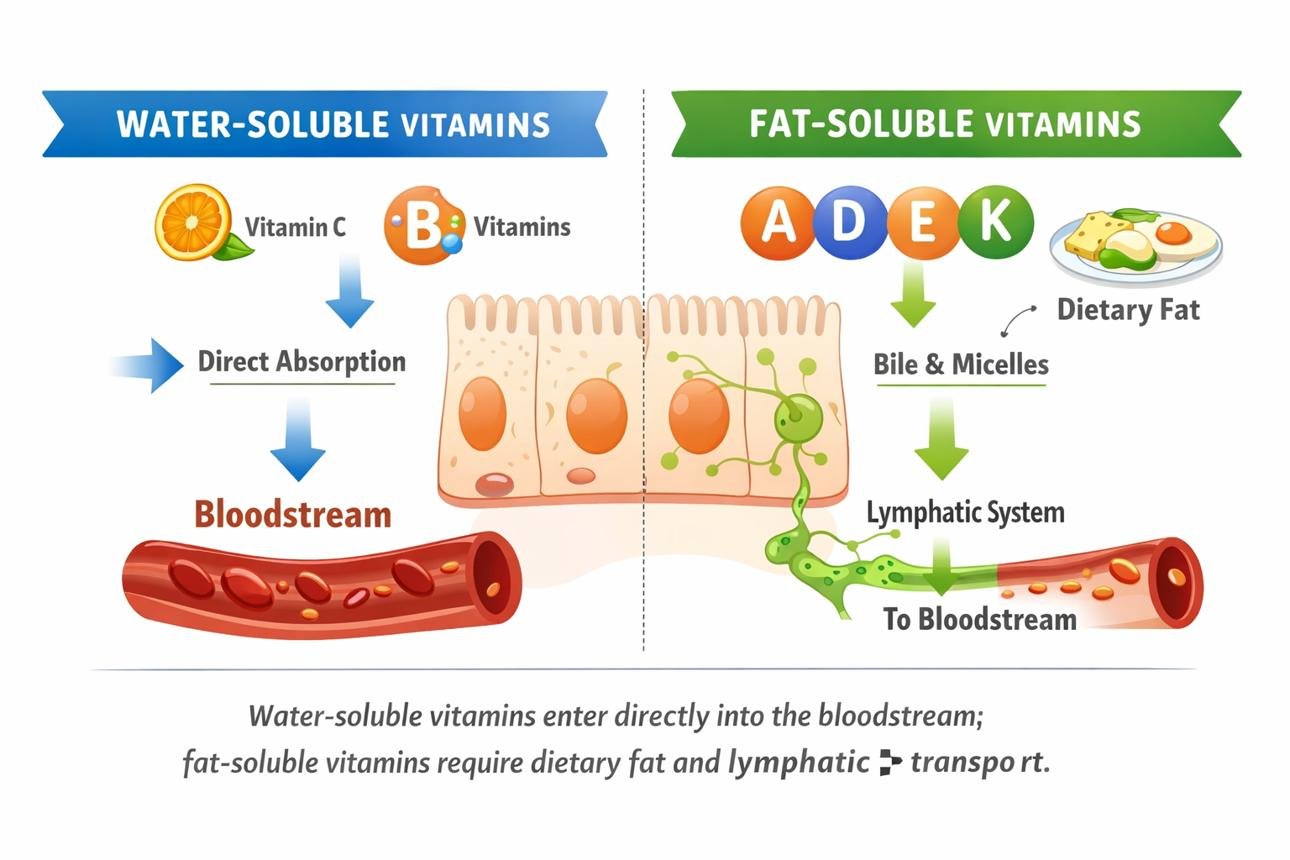
Unlike water-soluble vitamins, fat-soluble vitamins require dietary fat and normal digestive function for efficient absorption.
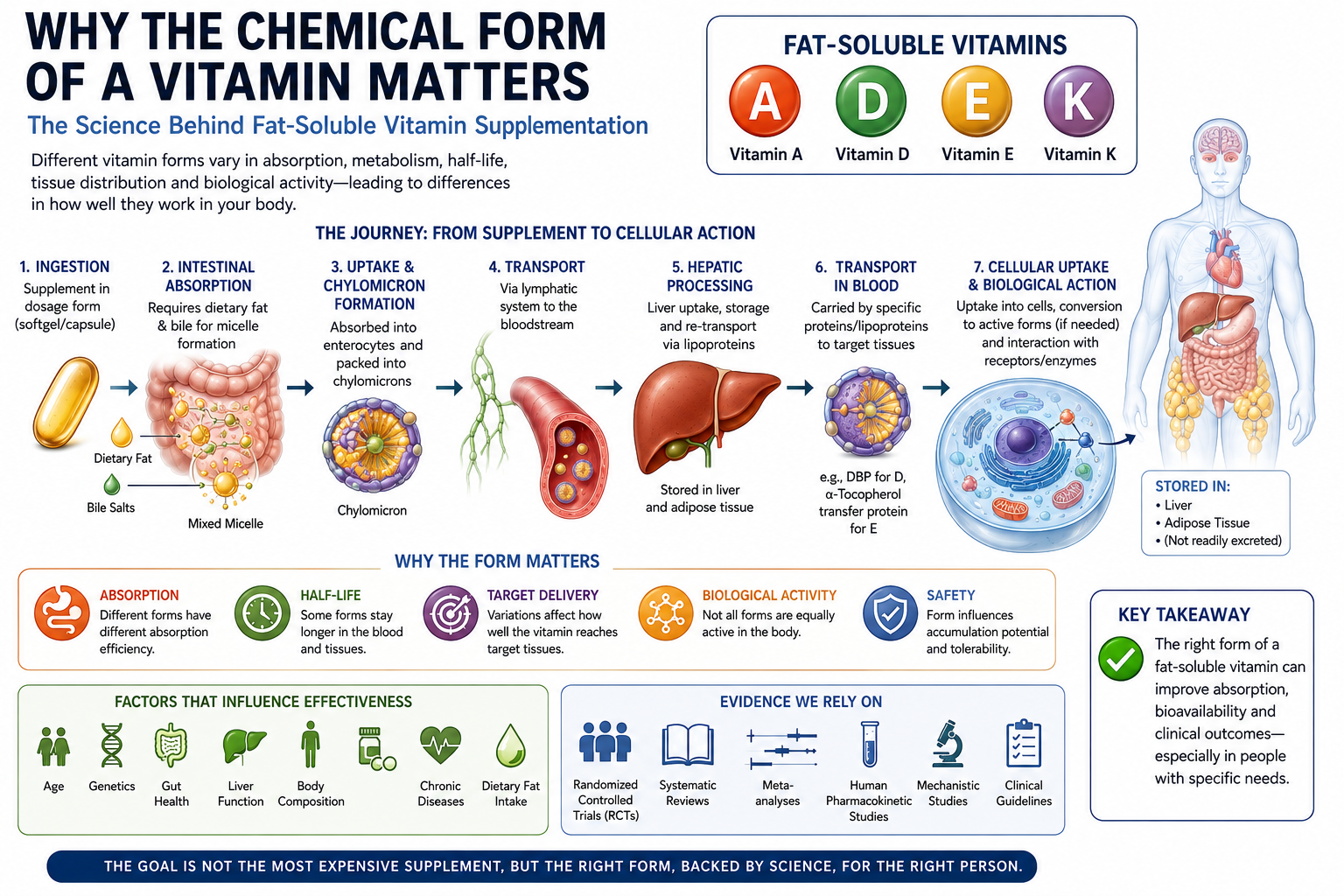
Following ingestion, they dissolve into mixed micelles formed by bile acids and dietary lipids within the small intestine. After absorption by intestinal enterocytes, they are packaged into chylomicrons and transported through the lymphatic system before entering the bloodstream. This pathway differs fundamentally from that of most water-soluble vitamins, which are transported directly into the portal circulation.
Because they are lipophilic, fat-soluble vitamins can be stored in the liver and adipose tissue. These reserves provide protection during periods of reduced intake but also increase the possibility of accumulation when supplements are consumed in excessive amounts over prolonged periods.
This storage capacity distinguishes fat-soluble vitamins from water-soluble vitamins, which are generally not retained in large amounts and therefore require more regular dietary intake.
Absorption Is More Than Taking a Pill
Supplement effectiveness depends on much more than swallowing a capsule. Successful delivery requires several physiological steps:
-
Release of the Vitamin from the supplement formulation
-
Formation of lipid micelles in the presence of bile salts
-
Uptake across the intestinal epithelium
-
Incorporation into chylomicrons
-
Lymphatic transport
-
Hepatic processing
-
Binding to specific transport proteins
-
Delivery into target tissues
-
Cellular activation where required
-
Interaction with receptors or enzymes that produce biological effects
Impairment at any stage can reduce the effectiveness of supplementation.
For example:
-
Chronic pancreatitis may impair fat digestion
-
Cholestatic liver disease reduces bile secretion
-
Celiac disease can damage absorptive surfaces
-
Crohn’s disease affecting the small intestine reduces nutrient uptake
-
Bariatric surgery alters digestive anatomy
-
Certain medications reduce absorption or metabolism
In these circumstances, choosing the most appropriate vitamin form—or adjusting the dose under medical supervision—may improve nutritional status
Bioavailability: One of the Most Misunderstood Concepts
The term bioavailability is widely used in supplement marketing but often poorly understood. Scientifically, bioavailability refers to the proportion of an ingested nutrient that is absorbed and becomes available for physiological use within body.
However, higher bioavailability alone does not automatically translate into superior health outcomes. A formulation may produce higher blood concentrations without demonstrating clinically meaningful benefits in randomized trials. Conversely, a less expensive formulation may provide equivalent long-term outcomes despite modest differences in pharmacokinetics.
For this reason, evaluating vitamin supplements requires consideration of multiple layers of evidence:
-
Chemical stability
-
Intestinal absorption
-
Pharmacokinetics
-
Tissue distribution
-
Biomarker responses
-
Clinical outcomes
-
Safety
The strongest recommendations arise when improvements in absorption are accompanied by demonstrated benefits in clinically relevant outcomes.
Separating Science from Marketing
The global dietary supplement industry is worth hundreds of billions of dollars annually, and innovation has produced numerous novel formulations. While many are based on sound biochemical principles, not every premium product has been validated in robust human clinical trials.
Throughout this series, each vitamin form will be evaluated using the same evidence hierarchy:
-
Human randomized controlled trials
-
Systematic reviews
-
Meta-analyses
-
Pharmacokinetic studies
-
Mechanistic research
-
Recommendations from recognized professional organizations