



Study That Shocked the Medical World Then and Continues to Intrigue Even Today – If you love your heart and care for your Heart Health, do read on this very interesting series – This is Part 1 of 2 -Part Series.
“Sometimes, the most important scientific discoveries begin with a simple observation that refuses to fit accepted beliefs” – Almost 60 Years Ago, this precise premise formed the basis for a Landmark Study known as Dr Malhotra’s 1967 Study, for its shocking and interesting findings. This is our most important blog for Your and Our Heart’s Health, do read and share widely.
Evolution of Cardio-Vascular Diseases
In the mid-1960s, cardiovascular disease was rapidly emerging as a major public health concern across the world. In Europe and North America, scientists increasingly believed that diets rich in saturated fat and cholesterol were the primary drivers of coronary heart disease. The now-famous “diet-heart hypothesis” was gaining momentum, and public health recommendations were beginning to encourage lower consumption of animal fats.
Thousands of kilometres away, in India, one physician noticed something that did not fit this emerging narrative and he set out to unravel it.
Dr. S. L. Malhotra, a physician with the Indian Railways Medical Service, and his observations would become one of the most intriguing—and controversial—chapters in Indian cardiovascular research, though relatively less referred to these days but intriguing still as they fly in face of “conventional, maybe unfounded, belief that saturated fats are not heart healthy and heart friendly”.
Nearly six decades later, the “Indian Railways Study” remains one of the most discussed historical investigations into diet, geography and heart disease. Although modern science has refined many of its interpretations, the study continues to remind researchers of an important lesson: biology is often more complex than our theories and our premises.
India in the 1960s: A Nation Beginning to Face Heart Disease
In the decades following independence, India was still largely affected by infectious diseases, malnutrition and maternal-child health challenges. Coronary artery disease was considered relatively uncommon compared with Western countries. Yet physicians working in large hospitals were beginning to notice a gradual increase in patients presenting with myocardial infarction (heart attack) and other forms of ischemic heart disease.
Most researchers assumed that as Indians adopted more “Western” eating habits, heart disease would naturally rise. However, one observation puzzled clinicians. Heart attacks did not appear to occur uniformly across the country. Some regions seemed to experience substantially fewer cases than others. Why?
Indian Railways: A Unique Natural Laboratory
Dr. Malhotra realised that the Indian Railways offered an exceptional opportunity to study this question. The railway system employed thousands of workers across different regions of India. Importantly, these employees shared many characteristics:
-
Similar employment conditions
-
Comparable access to medical care
-
Stable occupations
-
Standardised medical records
-
Regular health examinations
This reduced many of the socioeconomic differences that often complicate epidemiological studies. What differed most between employees stationed in North India and South India was their traditional dietary pattern and lifestyle.
This created what epidemiologists call a natural experiment—a situation where populations are similar in many respects but differ in one or more exposures of scientific interest.
A Surprising Observation
When Dr. Malhotra examined the medical records of railway employees, he observed an unexpected pattern.
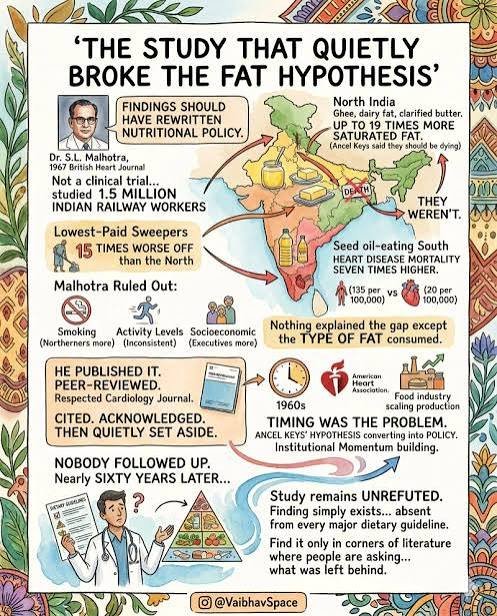
North Indian railway workers experienced markedly fewer myocardial infarctions than their counterparts in South India – You should read this again to understand a unique, population based difference in indiences of myocardial infacrtions.
This finding immediately attracted attention because it appeared to contradict prevailing nutritional thinking. At that time and 60-Years later, even today, many experts believe/d that diets rich in saturated fats should inevitably produce higher rates of coronary heart disease. Because, the dietary habits of these two populations painted a very different picture.
Two Regions. Two Very Different Diets.
One of the most striking features of the study was the contrast in traditional eating patterns.
North Indian Diet – Typical foods included: Milk, Curd, Buttermilk, Ghee, Butter, Whole wheat chapatis, Seasonal vegetables and Pulses. Animal-derived dairy fat contributed substantially to total dietary fat intake in North Indian Diets.
South Indian Diet – Traditional meals more commonly included: Rice, Idli, Dosa, Coconut preparations, Sambar, Vegetable dishes, coupled with Lower consumption of dairy products and Greater reliance on vegetable oils.
Conventional nutrition theory would have predicted that the higher intake of saturated dairy fat in North India should have resulted in more coronary disease. Instead, Dr. Malhotra observed the EXACT Opposite.
A copy of 1967 Dr S L Malhotra Study can be accessed here – DR S L Malhotra 1967 Study
Challenging the Diet-Heart Hypothesis
This observation represented one of the earliest Indian challenges to the growing belief that saturated fat alone explained coronary heart disease. The findings raised difficult questions. If saturated fat was the principal cause:
-
Why were North Indian railway employees experiencing fewer heart attacks?
-
Why did higher dairy fat intake not translate into proportionately higher cardiovascular mortality?
-
Could other dietary or lifestyle factors be modifying disease risk?
These questions would shape cardiovascular nutrition research for decades.
Looking Beyond Fat
One of the most remarkable aspects of Dr. Malhotra’s work was that he did not stop at dietary fat. Instead, he considered multiple explanations. His discussions explored several possibilities, including:
-
Overall dietary patterns
-
Meal composition
-
Physical activity
-
Occupational workload
-
Blood coagulation characteristics
-
Regional lifestyle differences
-
Metabolic adaptations
This systems-based approach was unusual for its time. Rather than attributing heart disease to a single nutrient, he recognised that multiple biological and environmental factors might interact. Today, this perspective aligns closely with modern concepts of nutritional epidemiology.
Why the Study Became So Influential
Although relatively small by today’s epidemiological standards, the Indian Railways investigation became internationally recognised because it questioned one of nutrition science’s dominant assumptions. Researchers around the world began asking new questions:
-
Could dietary patterns matter more than individual nutrients?
-
Were traditional foods being unfairly blamed?
-
Did fibre, physical activity or meal timing influence cardiovascular risk?
-
Could blood clotting mechanisms play a larger role than previously believed?
Many of these questions continue to be investigated even today.
Lessons That Still Matter
Nearly sixty years later, one message from Dr. Malhotra’s work remains remarkably relevant. Human nutrition cannot be understood by examining a single food or nutrient in isolation. Health is influenced by an intricate interaction between:
-
Overall dietary quality
-
Physical activity
-
Genetics
-
Metabolic health
-
Body composition
-
Gut microbiota
-
Sleep
-
Stress
-
Smoking
-
Environmental exposures