



Science of Human Growth: Genetics, Nutrition and the First 1,000 Days – An Evidence-Based Guide for Indian Parents, Adolescents and Healthcare Professionals
Really Why are Indians and Indian Children Short in Height?
One of the most common questions Indian parents ask is: “Can my child grow taller?”It is a simple question—but the scientific answer is surprisingly complex.
Height is not determined by a single gene, one glass of milk, a protein powder or a “height growth” supplement. Instead, it reflects years of interactions between genetics, nutrition, hormones, health, sleep, physical activity and the environment.
India has made remarkable progress in child health over the past few decades, yet millions of children still do not achieve their full growth potential. According to the National Family Health Survey (NFHS-5), approximately 35% of Indian children under five years of age are stunted, meaning they are too short for their age according to WHO growth standards. Stunting is not simply about stature—it reflects chronic undernutrition, repeated illness and adverse early-life conditions that can influence lifelong health, learning and productivity.
Importantly, being short is not always abnormal but does reflect the missed opportunity to grow taller. Some children inherit genes for shorter stature from their parents. The concern arises when a child fails to reach the height that their genetic potential would otherwise allow.
Sample some data –
In India, the average height is approximately 5 feet 5 inches (165 cm) for men and 5 feet (152 cm) for women.
Height can vary noticeably by region, with northern states like Punjab and Haryana recording higher averages (approx. 5 ft 7 in / 170 cm for men), while southern and eastern regions trend slightly lower. These figures are based on data compiled by health institutions and national health surveys. However, average height can differ due to a range of factors:
-
Regional Variation: Northern states tend to report taller populations, whereas southern and central regions generally see averages around 5 ft 4 in to 5 ft 6 in for men
-
Nutritional Impact: While genetics play a major role, dietary habits, socioeconomic backgrounds, and access to nutritional foods heavily influence these averages. Milk in particular does stands out for its impact on Human Height
This article explains why that happens.
What Does “Height Potential” Actually Mean?
Every child is born with a genetic blueprint that influences adult height. Researchers estimate that about 60–80% of adult height variation is explained by genetic factors, while the remaining variation reflects environmental influences such as nutrition, health, socioeconomic conditions and lifestyle.
Think of genetics as the architectural plan for a building. Nutrition and health determine whether the building is completed according to that plan. If construction materials are inadequate, the building may never reach its intended height—even though the blueprint allowed for it. The same principle applies to human growth.
Genetics: The Foundation of Height
More than 12,000 genetic variants have now been associated with adult height, according to large genome-wide association studies involving millions of participants. These genes influence:
-
Growth plate development / Bone formation
-
Cartilage growth / Hormone signaling
-
Skeletal maturation / Cell division
Rather than one “height gene,” hundreds to thousands of genes work together throughout childhood and adolescence. A child born to shorter parents is likely to be shorter than average. Likewise, children of taller parents often inherit the potential for greater adult height.
Clinicians commonly estimate a child’s expected adult height using the mid-parental height calculation. Mid-parental height is a formula pediatricians use to estimate a child’s genetic adult height potential based on the biological parents’ heights. While this provides only an estimate, it helps distinguish familial short stature from conditions that impair growth.
Genes Are Not Destiny for Your or Your Children’s Height
Although genetics play a major role, they are not the entire story. One of the clearest demonstrations comes from migration studies.
Children whose families migrate from regions with poorer nutrition to countries with better healthcare, sanitation and food security often grow significantly taller than previous generations. The same genetic background produces different adult heights because environmental conditions improve.
This tells us something very important: Genes set the potential. Environment determines how much of that potential is achieved.
Indian Growth Challenge – Boils Down to Nutrition, Unfortunately
India is home to the world’s largest population of children. It also carries one of the world’s largest burdens of childhood growth faltering. According to NFHS-5 (2019–21):
-
Approximately 35% of children under five are stunted
-
Around 19% are wasted (low weight for height)
-
About 32% are underweight
Although these figures represent substantial improvements compared with previous decades, they remain among the highest globally in absolute numbers. Stunting is particularly concerning because it reflects long-term nutritional and health challenges, not temporary illness.
Stunting Is More Than Short Height
Many parents believe stunting simply means “being short.” That is incorrect. The World Health Organization defines stunting as: Height-for-age more than two standard deviations below the WHO Child Growth Standards median.
Stunting reflects chronic constraints on growth during the most critical periods of development. Research consistently links childhood stunting with:
-
Lower educational achievement and Reduced adult earnings
-
Increased susceptibility to infections and Lower muscle mass
-
Greater risk of chronic disease later in life and Reduced work capacity
Preventing stunting therefore improves not only height but also long-term health and human capital.
Biology of Growing Taller
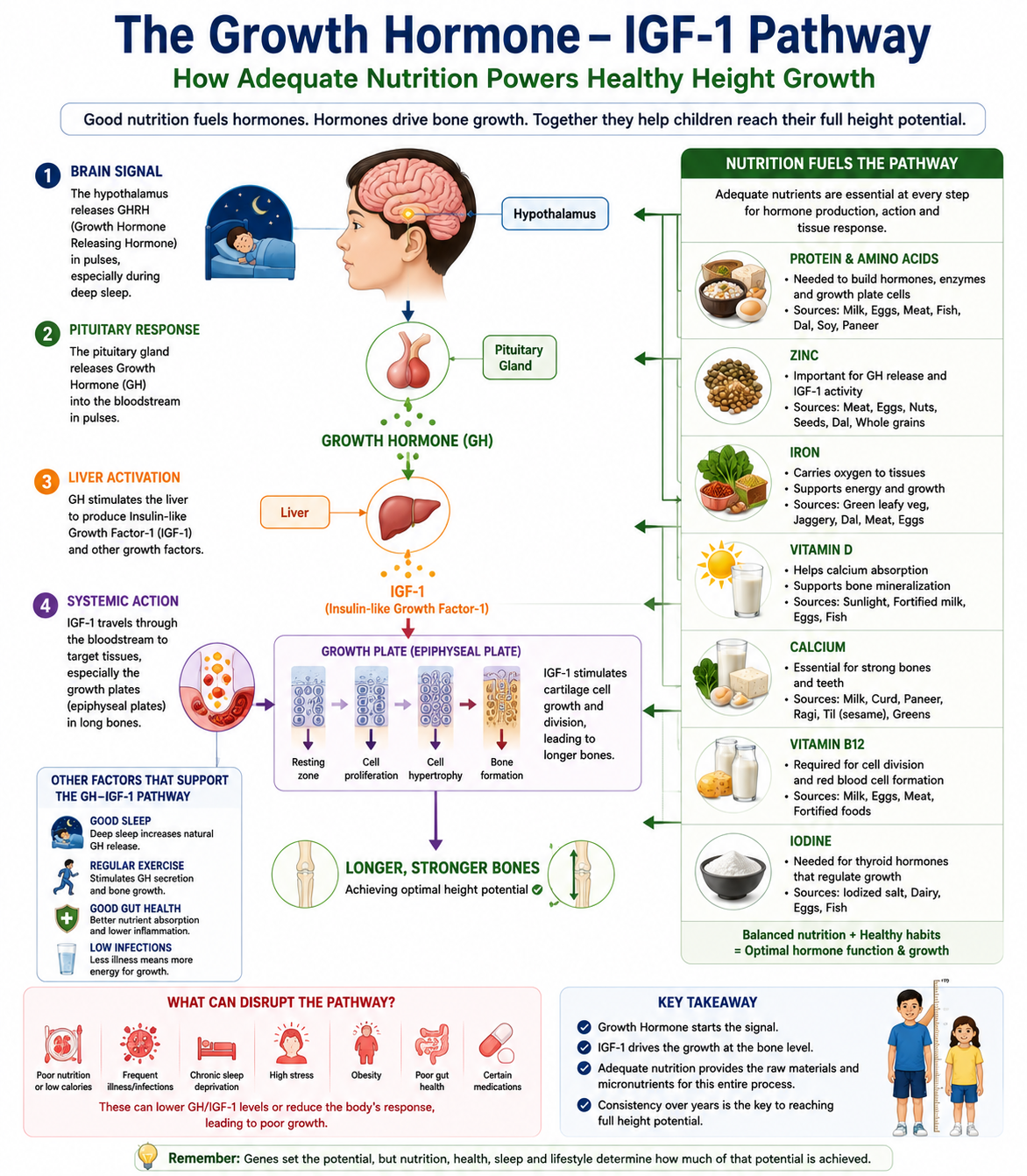
Bones do not lengthen randomly. Growth occurs at specialized structures called growth plates (epiphyseal plates), located near the ends of long bones. These growth plates contain cartilage cells that:
-
Multiply rapidly.
-
Mature and enlarge.
-
Become replaced by bone tissue.
This continuous process gradually lengthens the bones of the arms, legs and spine. Once puberty is complete, the growth plates fuse and further linear growth stops.
Growth Hormone: The Body’s Natural Growth Signal. One of the most important regulators of childhood growth is growth hormone (GH). Growth hormone is produced by the pituitary gland, a small gland located at the base of the brain. Unlike many hormones, GH is released in pulses, especially during deep sleep. Growth hormone helps:
-
Stimulate bone growth and Increases muscle protein synthesis
-
Promote fat breakdown and Supports normal metabolism
However, Growth Hormone rarely acts alone.
Meet IGF-1: The Real Driver of Bone Growth
Growth hormone stimulates the liver and several other tissues to produce Insulin-like Growth Factor-1 (IGF-1). IGF-1 directly stimulates:
-
Growth plate cartilage and Bone elongation
-
Muscle development and Protein synthesis
Children with inadequate IGF-1 activity often experience slower linear growth even when growth hormone secretion is normal. This explains why adequate nutrition is so important.
Without sufficient energy and quality nutrients, IGF-1 production falls—even if growth hormone levels remain normal.
Why Nutrition and Hormones Work Together – Growth hormones cannot build new tissue without raw materials. To build new bone and muscle, children require:
-
Adequate calories with High-quality animal proteins
-
Essential amino acids and Vitamins / Minerals
Poor nutrition reduces IGF-1 concentrations, slowing growth plate activity and limiting height gain. This Poor Nutrition in Indians is the biggest cause of relatively shorter height, not so much as genetics.
First 1,000 Days of Life: Most Important Window for Growth
Perhaps no period influences lifelong growth more than the first 1,000 days. This includes: Pregnancy of approximately 270 days and from Birth to two years of age.
During this period: Brain develops rapidly, Bones grow quickly, Organs mature and Immune function develops. Nutritional deficiencies can have lasting consequences during this phase. For this reason, international health organizations describe the first 1,000 days as the golden window for preventing stunting.
Pregnancy: Growth Begins Before Birth – A child’s growth does not start at birth. It begins in the womb. Maternal health strongly influences fetal growth through Nutrient supply, Placental function, Blood flow and Oxygen delivery.
Maternal undernutrition, severe anemia, poorly controlled diabetes, smoking, alcohol exposure and certain infections can all affect fetal growth. Low birth weight increases the likelihood of later growth faltering including poor cognitive development, although many infants experience healthy catch-up growth with appropriate nutrition and medical care.
Why Weight at Birth Matters More
Healthy weight at Birth reflects successful fetal growth. Infants born with low birth weight are at greater risk of: Childhood stunting, Cognitive Developmental delays, Infections and Adult metabolic diseases, later in life.
India continues to have one of the world’s highest numbers of low-birth-weight infants, highlighting the importance of maternal nutrition and antenatal care.
Breastfeeding and Early Growth – World Health Organization recommends:
-
Exclusive breastfeeding for the first six months of life
-
Continued breastfeeding alongside complementary feeding up to two years or beyond
Breast milk provides: Good Energy, High-quality protein, Essential fats, Immune factors and Bioactive compounds. All these support healthy growth of infants and reduce the risk of infections, which themselves can impair growth. In addition, breast feeding is protective for mothers also – from potential breast cancers, later in life.
Key Takeaways
-
Adult height is influenced by both genetics and environmental factors and environmental factors are controolable and are in our own hands
-
Genes determine the potential for growth, but nutrition, health and lifestyle determine how much of that potential is actually achieved
-
India continues to face a significant burden of childhood stunting despite substantial progress in recent decades
-
Growth occurs through specialized growth plates under the influence of growth hormone and IGF-1
-
The first 1,000 days—from conception to two years of age—represent the most critical period for lifelong growth and development
-
Maternal health, birth weight, breastfeeding and appropriate complementary feeding all play essential roles in helping children reach their genetic height potential
Select References
-
World Health Organization. WHO Child Growth Standards. Geneva: WHO
-
National Family Health Survey (NFHS-5), India (2019–21)
-
Indian Council of Medical Research–National Institute of Nutrition (ICMR–NIN). Nutrient Requirements for Indians, 2024
-
Indian Academy of Pediatrics. Growth Monitoring Guidelines
-
Wood AR, et al. Defining the role of common variation in the genomic architecture of adult human height. Nature Genetics
-
Yengo L, et al. Meta-analysis of genome-wide association studies for height and body mass index. Human Molecular Genetics
-
Victora CG, et al. Maternal and child undernutrition: consequences for adult health and human capital. The Lancet
-
de Onis M, Branca F. Childhood stunting: a global perspective. Maternal & Child Nutrition
-
Black RE, et al. Maternal and child undernutrition and overweight in low-income and middle-income countries. The Lancet
-
UNICEF India. Child Nutrition Reports