


Introduction
Every heartbeat of ours, begins with a tiny electrical impulse. In a healthy heart, these impulses travel through specialised pathways in a highly organised sequence, allowing the heart to contract rhythmically about 100,000 times every day.
But when this electrical system is disturbed, the heart may beat too fast, too slow or irregularly—a condition known as an arrhythmia. Arrhythmias range from harmless skipped beats to life-threatening disorders that can lead to stroke, heart failure or sudden cardiac death.
Over the past 25 years, researchers have increasingly recognised that magnesium plays a fundamental role in maintaining the heart’s electrical stability. In fact, intravenous magnesium has become a standard treatment for certain emergency rhythm disorders, while oral magnesium supplementation has been studied for preventing atrial fibrillation, premature beats and post-operative arrhythmias.
The question is: How strong is the evidence? Let’s examine what the science tells us.
Why Magnesium Is Essential for the Heart’s Electrical System
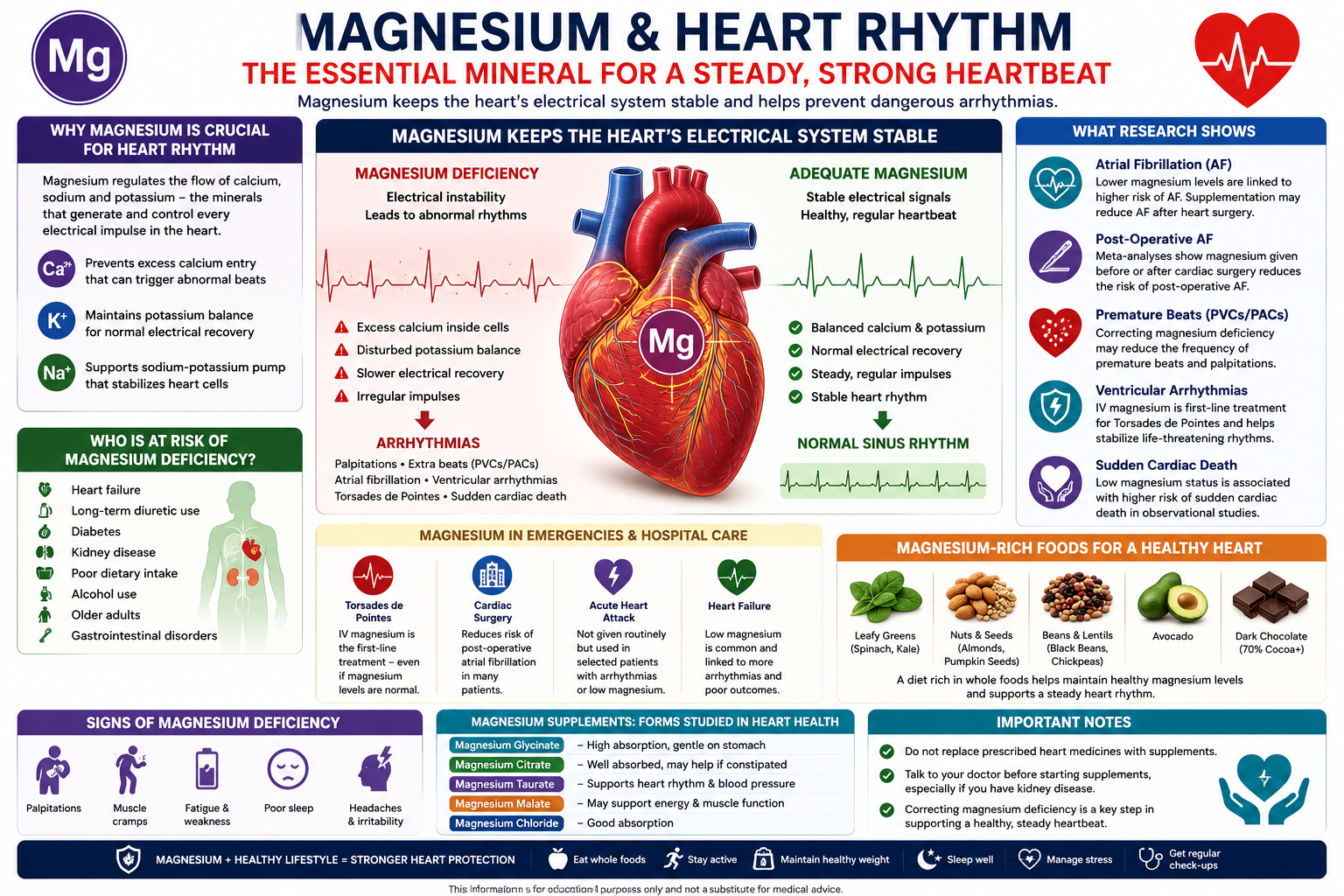
Unlike many nutrients that influence cardiovascular health indirectly, magnesium acts directly on the electrical activity of heart muscle cells. It helps regulate the movement of: Calcium, Potassium and Sodium.
These three minerals generate the electrical signals responsible for every heartbeat. Without adequate magnesium:
- Calcium enters heart cells excessively
- Potassium balance becomes unstable
- Electrical recovery after each heartbeat slows
- Heart muscle becomes more excitable
The result is a greater tendency for abnormal heart rhythms.
Magnesium: Nature’s Electrical Stabiliser
Cardiologists often describe magnesium as a physiological calcium antagonist. In simple terms, magnesium prevents excessive calcium from entering heart muscle cells. This is important because excessive intracellular calcium can:
- Trigger premature heartbeats
- Increase electrical instability
- Promote abnormal automaticity
- Increase the likelihood of dangerous arrhythmias
Magnesium also supports the sodium-potassium ATPase pump, which restores normal electrical balance after every heartbeat. Without adequate magnesium, this recovery process becomes less efficient.
What Happens During Magnesium Deficiency?
Low magnesium levels may cause: Palpitations, Extra heartbeats (ectopic beats), Premature ventricular contractions (PVCs), Premature atrial contractions (PACs), Atrial fibrillation and Ventricular arrhythmias in susceptible individuals.
Hospital studies consistently show that low serum magnesium is associated with higher rates of rhythm disturbances, especially in critically ill patients. There are a number of Indian studies on Indian patients corroboarting the fact that more Indian patients have cardiac arrythmias after cardiac surgeries, if their blood serum levels are lower before start of surgeries.
Magnesium and Atrial Fibrillation (AF)
Atrial fibrillation (AF) is the most common sustained heart rhythm disorder worldwide. Instead of contracting normally, the upper chambers of the heart quiver rapidly and irregularly.
AF increases the risk of: Stroke, Heart failure, Dementia, Hospitalisation and Premature death
Researchers, including many Indian Doctors have examined magnesium’s role in three major settings:
- Preventing AF after cardiac surgery
- Reducing recurrent AF
- Improving rhythm control during treatment
Post-Operative Atrial Fibrillation: One of Magnesium’s Strongest Areas of Evidence
Between 20% and 50% of patients including in India, undergoing heart surgery develop atrial fibrillation within a few days of the procedure. This complication increases:
Length of hospital stay
Healthcare costs
Stroke risk
Recovery time
Multiple randomised controlled trials have investigated whether magnesium supplementation can reduce this complication – 2 of Indian Published studies ( 1 from AIIMS Patna) are hyperlinked here.
What Do Meta-Analyses Show?
Several meta-analyses have found that magnesium supplementation around the time of cardiac surgery reduces the incidence of post-operative atrial fibrillation. Benefits appear greatest when magnesium is given intravenously before or shortly after surgery, particularly in patients with low magnesium levels.
Although study protocols differ, the overall evidence suggests magnesium is a useful component of perioperative care in selected patients.
Can Magnesium Prevent Everyday Atrial Fibrillation?
This is a more complex question. Some observational studies have found that people with lower magnesium levels have a higher risk of developing AF over time.
Large cohort studies, including the Framingham Heart Study and the Atherosclerosis Risk in Communities (ARIC) Study, reported associations between lower magnesium status and increased AF risk. However, oral magnesium supplementation has not consistently prevented AF in otherwise healthy adults. Current evidence suggests that magnesium is most helpful when:
Magnesium deficiency is present
AF occurs after surgery
Patients have electrolyte imbalances
Certain anti-arrhythmic treatments are being used
Magnesium and Premature Heartbeats (PVCs and PACs)
Several small clinical studies suggest that correcting magnesium deficiency may reduce the frequency of premature beats, particularly in people with documented low magnesium intake.
However, evidence remains limited, and larger high-quality trials are needed before routine supplementation can be recommended solely for PVCs or PACs.
Role of Magnesium in Heart Health
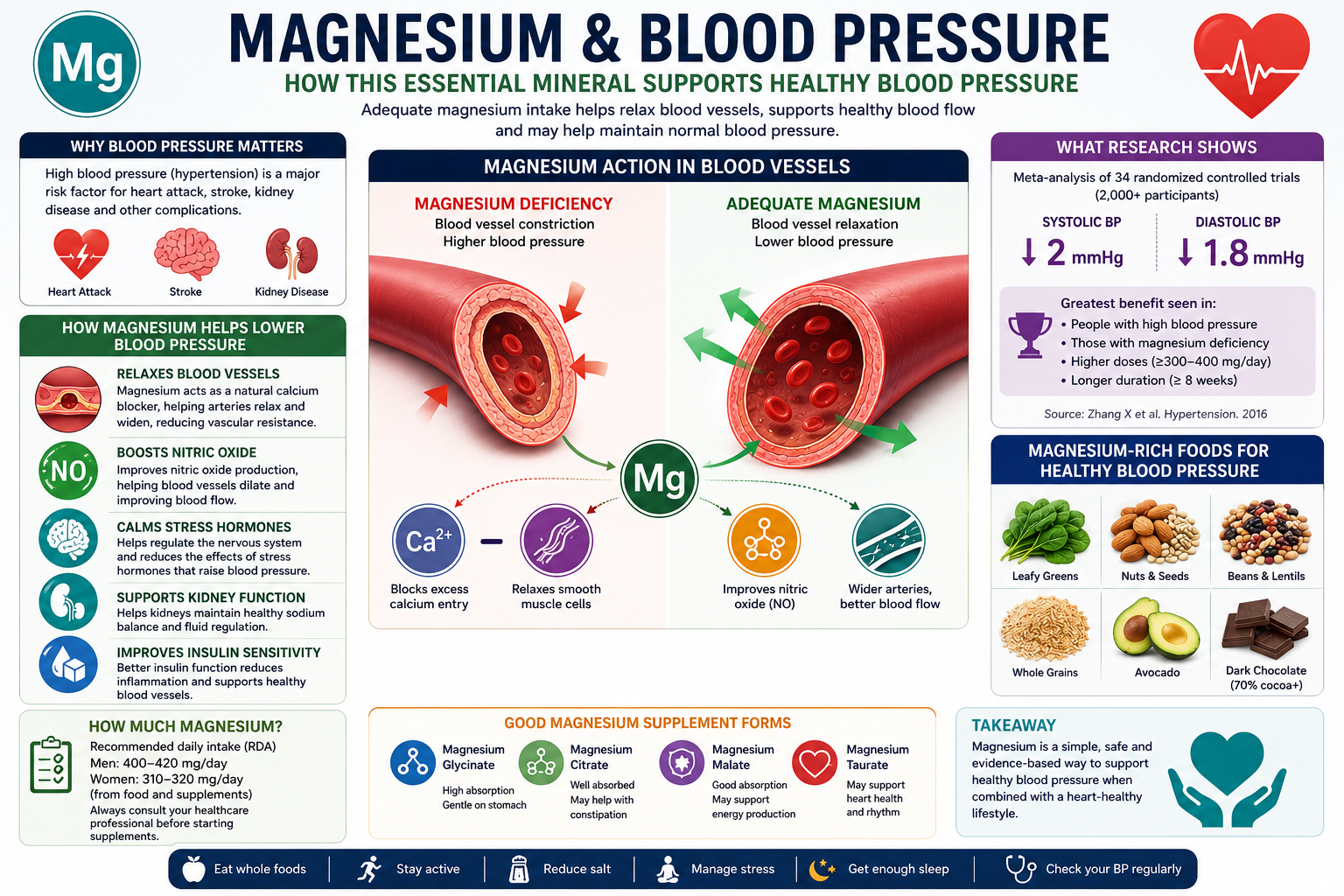
1. Magnesium Relaxes Blood Vessels – One of magnesium’s best-known functions is acting as a natural calcium blocker. Calcium causes smooth muscle in blood vessel walls to contract. Magnesium does exactly the opposite. It allows blood vessels to relax and widen. Wider arteries mean:
Lower vascular resistance
Easier blood flow
Lower blood pressure
Reduced workload on the heart
This effect resembles, on a much smaller scale, the mechanism of calcium channel blocker medications used to treat hypertension.
2. Magnesium Improves Nitric Oxide Production – Healthy arteries produce nitric oxide. Nitric oxide actually Relaxes arteries, Prevents excessive constriction, Improves blood flow and Protects blood vessels.
Low magnesium levels reduce nitric oxide availability. Several studies show that restoring magnesium improves endothelial function—the ability of blood vessels to dilate normally.
Pro Tip – Indian Praanayam, especially Bhramari (Humming Bee Breath) is a powerful yogic breathing technique that can increase the production of nasal nitric oxide (NO) by up to 15 times compared to regular nasal breathing. This surge in NO acts as a potent vasodilator, improving blood circulation, reducing inflammation, and enhancing oxygen uptake. Bhramari costs nothing but just a few minutes of your time, start today for its benefits. Our Yogis knew science way before, validation by the Framingham studies of the world.
3. Magnesium Reduces Overactive Stress Hormones – Chronic stress activates:
Adrenaline
Noradrenaline
Cortisol
These hormones increase: Heart rate, Blood vessel constriction and Blood pressure. Magnesium helps regulate the nervous system and may reduce excessive sympathetic nervous system activity.
This is one reason why magnesium deficiency is often associated with: Anxiety, Poor sleep, Muscle tension and Elevated blood pressure
4. Magnesium Helps Kidneys Balance Sodium – The kidneys regulate: Sodium, Potassium, Magnesium and Water. When magnesium intake is low, sodium balance becomes less efficient. Higher sodium retention increases blood pressure. Adequate magnesium appears to improve sodium handling and may enhance the blood pressure benefits of reducing dietary salt.
5. Magnesium Improves Insulin Sensitivity – Many people with hypertension also have: Obesity, Prediabetes, Type 2 diabetes and Metabolic syndrome.
Its a proven fact that Magnesium improves insulin sensitivity. Better insulin function reduces: Chronic inflammation, Blood vessel stiffness and Sympathetic nervous system activation. All of these contribute to healthier blood pressure.

Magnesium Sources – Food First: Increasing Serum Magnesium Naturally
Many magnesium-rich foods also support heart health because they provide:
Fibre
Potassium
Healthy fats
Antioxidants
Excellent dietary sources of Magnesium include:
| Food | Serving size | Magnesium content in milligrams (mg) |
|---|---|---|
| Pumpkin seeds (pepitas) | 30 grams | 159 mg |
| Chia seeds | 30 grams | 114 mg |
| Almonds | 30 grams | 80 mg |
| Cashews | 30 grams | 75 mg |
| Brown rice (cooked) | ½ cup | 72 mg |
| Spinach (boiled) | ½ cup | 57 mg |
| Peanuts | 30 grams | 48 mg |
| Salmon (cooked) | 100 grams | 30 mg |
| Milk (3% fat) | 1 cup | 28 mg |
| Whole wheat bread | 1 slices | 25 mg |
| Chicken breast | 80 grams | 24 mg |
| Avocado | 75 grams | 20 mg |
| Meat, mince (cooked) | 65 grams | 18 mg |
Key Takeaways
The evidence accumulated over the last 25 years is remarkably consistent. Magnesium although is not a miracle cure for hypertension, but is essential nutrient and there are more risks, absolutely avoidable, with deficiency of Magnesium. The strongest evidence suggests that magnesium:
- Helps relax blood vessels
- Improves endothelial function
- Supports nitric oxide production
- Enhances insulin sensitivity
- Modestly reduces blood pressure, especially in people with magnesium deficiency or hypertension
- Works best as part of an overall heart-healthy lifestyle
For millions of Indians whose diets fall short in Magnesium-rich foods, improving magnesium intake may be a simple, safe and evidence-based strategy to support cardiovascular health. This is the least we can do for our Good Heart.
Key Scientific References
-
Patel UH, Jagrit NN, Madole MB, Panchal SS. Correlation of magnesium and calcium in the management of cardiac arrhythmia: Perspectives for better outcome. Adesh Univ J Med Sci Res 2021;3:85-90
-
Kotecha, D 2016, ‘Magnesium for Atrial Fibrillation: Myth or Magic?‘, Circulation Arrhythmia and Electrophysiology, vol. 9, no. 9. https://doi.org/10.1161/CIRCEP.116.004521
-
Zhang X, et al. Magnesium supplementation improves blood pressure in adults: A meta-analysis of 34 randomized double-blind placebo-controlled trials. Hypertension. 2016
-
Kass L, et al. Effect of magnesium supplementation on blood pressure: Meta-analysis. European Journal of Clinical Nutrition. 2012
-
Rosanoff A, et al. Suboptimal magnesium status in the United States: Are the health consequences underestimated? Nutrition Reviews. 2012
-
Song Y, et al. Dietary magnesium intake and risk of hypertension: Prospective cohort studies and meta-analysis
-
NIH Office of Dietary Supplements. Magnesium Fact Sheet for Health Professionals