



This is Concluding, Part 2 of our Series on – What Clinical Trials Reveal About Vitamin K2, Vitamin D3 and Heart Health – and what this menas for Indians.For Part-1, Pls Click Here.
Introduction
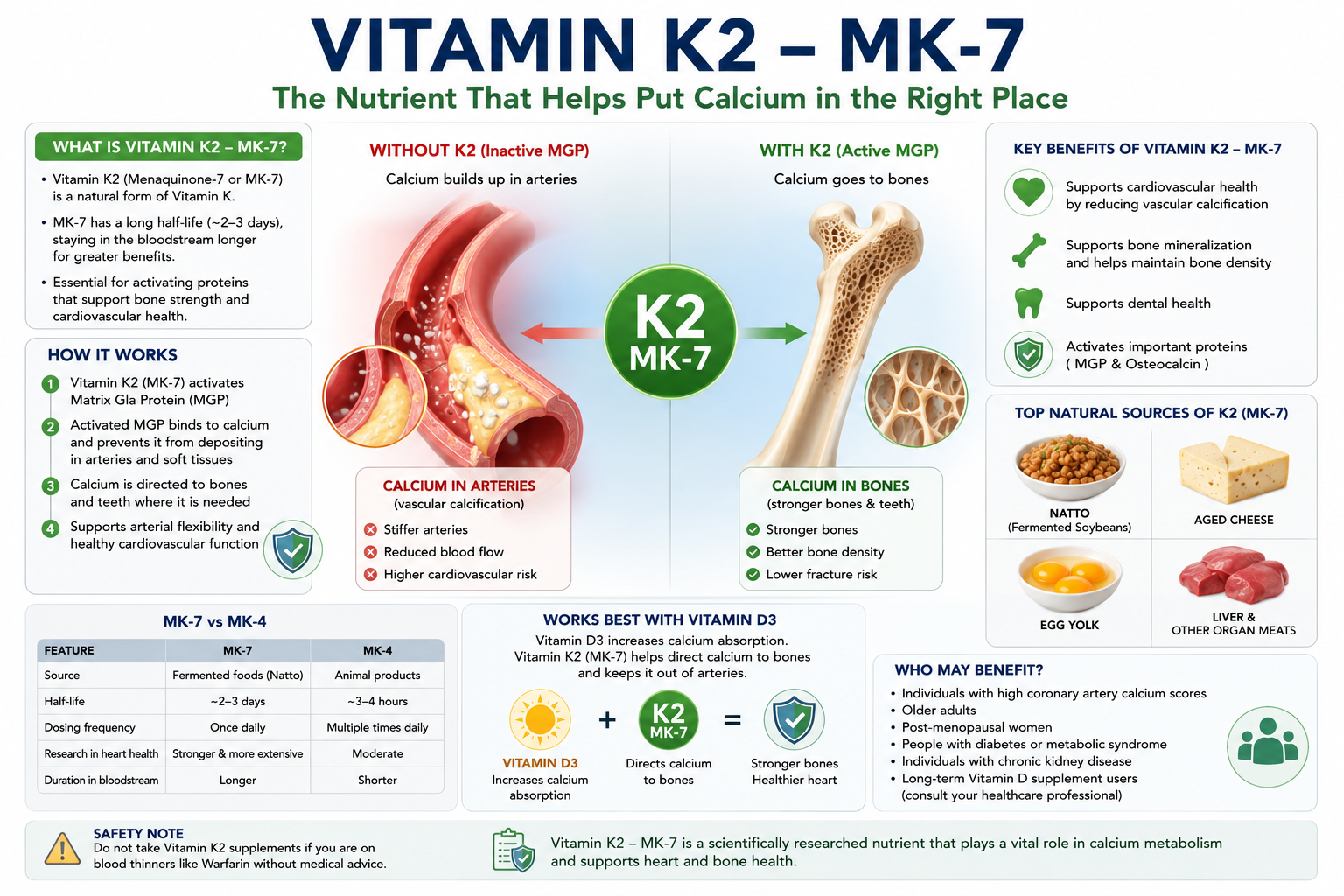
In Part 1, we explored how coronary artery calcification (CAC) develops, why it predicts future cardiovascular risk, and how Vitamin K2 activates Matrix Gla Protein (MGP)—one of the body’s natural defences against calcium deposition within blood vessels. We also learnt why Indians have relatively higher levels of deficiencies of both Vit D3 and Vit K2.
The biological mechanisms are compelling. Laboratory research has shown that Vitamin K2 activates proteins that inhibit vascular calcification, while observational studies suggest that people consuming more Vitamin K2 tend to have lower rates of arterial calcification and cardiovascular disease. However, an important question remains: Do Vitamin K2 supplements actually slow coronary artery calcification or reduce heart disease in people? To answer that, we must turn to human clinical trials.
Why Human Clinical Trials Matter
Laboratory studies and animal experiments help scientists understand how nutrients work inside the body. Observational studies can identify important associations between diet and disease.
But only randomised controlled trials (RCTs) can determine whether a supplement truly causes a health benefit. For Vitamin K2, the evidence is very encouraging—and still is developing. Most published trials have focused on:
Progression of vascular calcification
Arterial stiffness
Activation of Matrix Gla Protein
Bone metabolism
Cardiovascular biomarkers
Only a limited number have been large enough or long enough to assess major outcomes such as heart attack or cardiovascular death.
Clinical Trial Evidence: What We Know So Far
1. The VitaK-CAC Trial
One of the most discussed studies – VitaK-CAC Trial showed that daily vitamin K2 (menaquinone-7 or MK-7) supplementation modestly slows the progression of coronary artery calcification (CAC) in patients with symptomatic coronary artery disease. Published in JAMA Cardiology, the 2-year randomized trial tested 360 µg of oral MK-7 versus a placebo. Key findings:
-
Progression of coronary artery calcification appeared slower in some higher-risk participants
-
The benefit was more apparent among individuals with pre-existing coronary calcification
-
Changes were modest rather than dramatic
What the study tells us – The results suggest that Vitamin K2 may influence the progression of vascular calcification, but they do not prove that supplementation prevents heart attacks or reverses existing calcium deposits.
2. The AVADEC Trial
The AVADEC trial evaluated whether combining Vitamin D3 and Vitamin K2 could influence vascular health in older adults. The AVADEC (Aortic Valve Decalcification) trial is a randomized, double-blind, placebo-controlled study that tested whether daily high-dose vitamin K2 and D3 supplementation could slow the progression of aortic valve calcification (AVC) and coronary artery calcification
Researchers assessed arterial stiffness and vascular biomarkers over time. Findings:
-
The combination improved markers of Vitamin K status and successfully activated Matrix Gla Protein
-
However, improvements in clinical cardiovascular outcomes were less clear
The trial reinforced an important concept: Improving biological markers does not automatically translate into fewer cardiovascular events.
3. Chronic Kidney Disease Studies
Patients with chronic kidney disease (CKD) develop vascular calcification much faster than the general population. Several clinical studies led by Professor Vincent Brandenburg and colleagues have examined Vitamin K supplementation in this high-risk population. Researchers consistently found that:
-
Vitamin K supplementation significantly reduced levels of inactive Matrix Gla Protein (dp-ucMGP)
-
Activation of MGP improved
-
Vitamin K deficiency appeared to be common among CKD patients
However, despite these encouraging biological effects, convincing reductions in cardiovascular events have not yet been demonstrated. Large outcome trials remain ongoing.
4. Studies on Arterial Stiffness
Several smaller clinical trials have investigated whether MK-7 improves arterial elasticity. Some studies reported: Reduced arterial stiffness, Improved vascular elasticity and Better activation of Vitamin K-dependent proteins.
These findings support the biological role of Vitamin K2 in vascular health. However, study sizes were generally small, and results have not been completely consistent across all populations.
Vitamin K2: MK-4 or MK-7?
One of the most common questions patients ask is: Which form of Vitamin K2 is better? The answer depends on the intended purpose.
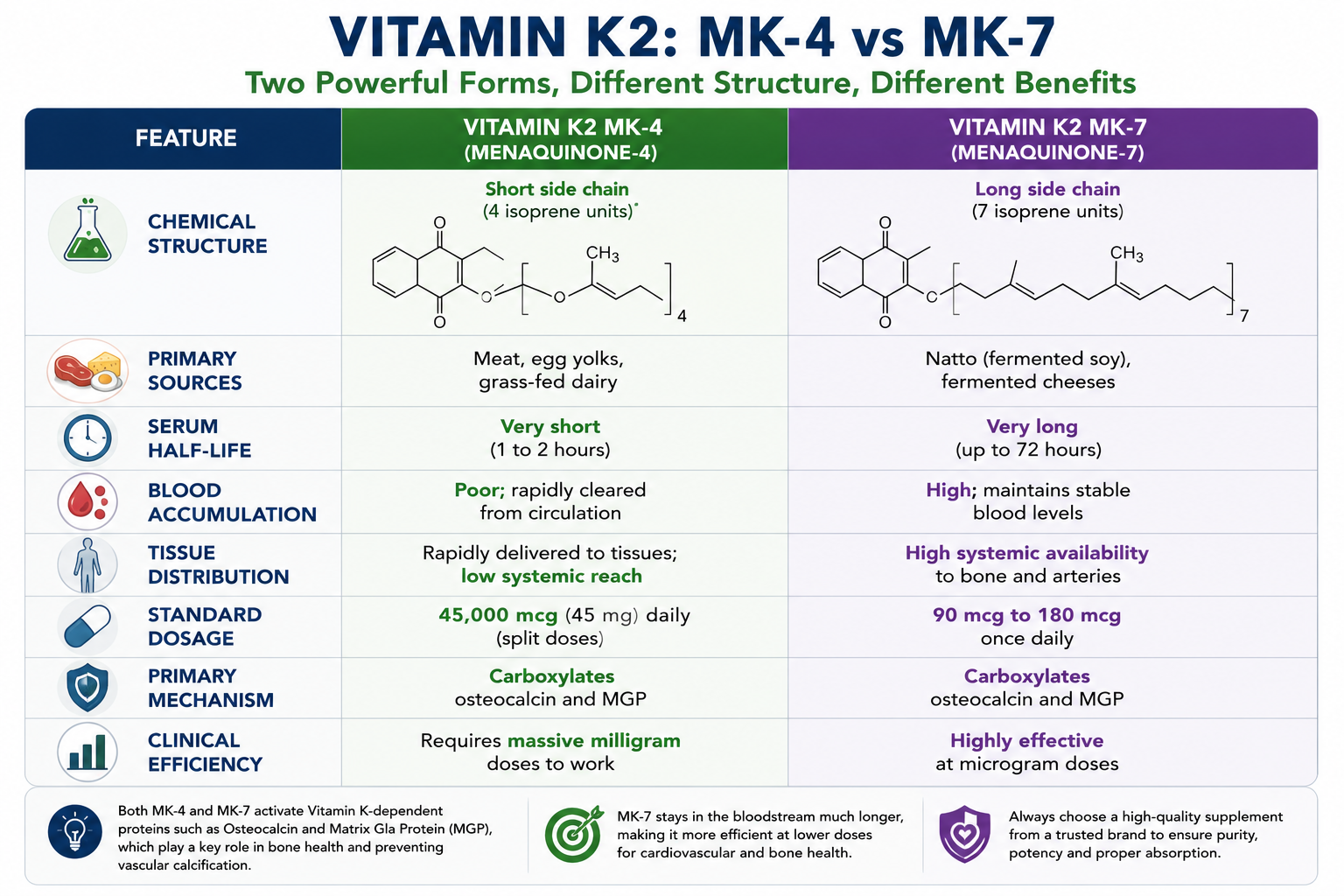
Because MK-7 remains in the bloodstream much longer, it has become the preferred form in most cardiovascular nutrition studies.
Why Vitamin D and Vitamin K2 Are Often Taken Together
Vitamin D and Vitamin K2 perform complementary functions in calcium metabolism.
Vitamin D
Increases calcium absorption from the intestine
Supports bone mineralisation
Helps maintain normal blood calcium levels
Vitamin K2
Activates Matrix Gla Protein
Activates osteocalcin, another Vitamin K-dependent protein important for bone health
Helps regulate calcium utilisation
This complementary relationship has led many supplement manufacturers to combine Vitamins D3 and K2. However, current evidence is evolving to show that everyone taking Vitamin D should automatically take Vitamin K2.
For healthy individuals with adequate nutrition FROM ANIMAL MEATS and Dairy Products, there is insufficient evidence to recommend routine combination therapy solely for preventing coronary artery calcification.
Who May Potentially Benefit Most?
Although routine supplementation is recommended for adults and at risk people, researchers believe several groups of Indians deserve further study. These include:
Older Adults – Ageing is associated with increasing vascular calcification and lower dietary Vitamin K intake. Older people have relatively lower intakes of animal meats and dairy products
People with Type 2 Diabetes – Diabetes accelerates vascular calcification through inflammation, oxidative stress and metabolic disturbances. These people greatly stand to benefit from Vit K2 supplementation or from animal meats and dairy products sources which can also help lower their daily intakes of high carbohydrate diets
Individuals with Chronic Kidney Disease – This group develops vascular calcification rapidly and frequently demonstrates poor Vitamin K2 status and hence supplementation may help greatly.
Post-Menopausal Women – Maintaining both bone and vascular health becomes increasingly important after menopause.
People with Established Coronary Artery Calcification – Some researchers believe this population may benefit the most from Vitamin K supplementation and future intervention studies.
Is Vitamin K2 Safe?
Vitamin K2 has an excellent safety profile in healthy adults. Clinical trials have generally reported very few adverse effects, if any. However, one important exception exists.
Warfarin Users – People taking warfarin or other Vitamin K antagonist anticoagulants should not start Vitamin K supplements without medical supervision. Vitamin K directly influences blood clotting pathways and may interfere with anticoagulant therapy.
Individuals taking newer direct oral anticoagulants (DOACs) should also still discuss supplementation with their healthcare provider.
What Do Major Cardiology Guidelines Say?
Where Is the Research Heading?
Interest in Vitamin K2 has expanded rapidly during the past decade. Scientists are now investigating:
Larger randomised controlled trials
Long-term coronary calcium progression
High-risk diabetes populations
Chronic kidney disease
Healthy ageing
Combination therapy with Vitamin D3
Personalised nutrition based on Vitamin K status
Future studies should help determine whether improving Vitamin K status can translate into measurable reductions in cardiovascular events.
Practical Take-Home Messages
Current evidence allows several practical conclusions such as:
✔ Vitamin K2 plays a well-established role in activating Matrix Gla Protein, one of the body’s natural inhibitors of vascular calcification
✔ Higher dietary Vitamin K2 intake has been associated with lower cardiovascular risk in several observational studies – the sources of Vit K2 are largely animal original meats, egg yolk and cheese, dairy products
✔ Clinical trials suggest Vitamin K2 may improve biomarkers of vascular health and slow calcification progression in selected groups
✔ Evidence is strongest for MK-7, which has a much longer half-life than MK-4 and has been used in most cardiovascular studies
✔ There is emerging evidence that Vitamin K2 reverses existing coronary artery calcification
Final Verdict
The story of Vitamin K2 and coronary artery calcification is one of the most exciting developments in nutritional cardiology.
Unlike many nutrition trends driven by marketing, the interest in Vitamin K2 is supported by a strong biological rationale. Scientists understand how Vitamin K2 activates Matrix Gla Protein, how this protein helps regulate calcium metabolism, and why inadequate Vitamin K status may contribute to vascular calcification.
Observational studies consistently suggest that higher Vitamin K2 intake is associated with better cardiovascular outcomes, while clinical trials indicate that MK-7 can improve important biological markers linked to vascular health.
At the same time, scientific integrity requires acknowledging what remains uncertain. There is currently no definitive evidence that Vitamin K2 supplementation prevents heart attacks or reverses coronary artery calcification, except it slows down arterial calcification, which also is significant.
For now, the best approach remains a comprehensive cardiovascular prevention strategy that includes a healthy diet, regular physical activity, blood pressure and cholesterol control, diabetes management, smoking cessation, and appropriate medical care. Vitamin K2 is becoming an important part of this strategy, choice is to get it from animal meat sources, dairy products or from supplements.
Select References:
-
Geleijnse JM, et al. Dietary intake of menaquinone is associated with reduced risk of coronary heart disease: The Rotterdam Study. Journal of Nutrition
-
Gast GCM, et al. Prospect-EPIC Cohort: Vitamin K intake and coronary heart disease. Journal of Nutrition
-
Brandenburg VM, et al. Vitamin K supplementation and vascular calcification in chronic kidney disease. Kidney International
-
Shea MK, Booth SL. Vitamin K in cardiovascular health. Advances in Nutrition
-
Schurgers LJ, et al. Vitamin K-dependent proteins and vascular calcification. Blood
-
Rennenberg RJMW, et al. Chronic coumarin treatment and vascular calcification. Blood
-
European Society of Cardiology (ESC). Guidelines on Cardiovascular Disease Prevention
-
American College of Cardiology/American Heart Association (ACC/AHA). Guidelines for Primary Prevention of Cardiovascular Disease
-
Nutrients. Recent reviews on Vitamin K2, Matrix Gla Protein and vascular calcification
-
Atherosclerosis. Systematic reviews on Vitamin K and cardiovascular outcomes